![]() |
| Part of Sophia's story she wrote for publication in prison |
![]() |
| Me , Ian Strelley and Andrew when we met in Canada |
A Genealogy blog recording family history and stories, WWI tributes, research tips and more. Now including DNA for beginners!
![]() |
| Part of Sophia's story she wrote for publication in prison |
![]() |
| Me , Ian Strelley and Andrew when we met in Canada |
As we move into the Festive season 2025, let's reflect on
our ancestors who were serving at war during the Boer War and 110 years ago
during the 1914-18 First World War.
Here are three snippets.
Frederick Clayton Bateman Strelley 1883-1955. Fred served in both the
Boer War and the First World War. Among his war memorabilia were relics of
Christmases served in both wars.
| Fred's wartime memorabilia |
| 1914 Brass Box |
These tins were a personal gift from the future Queen to each soldier who was
serving in the British Army in Christmas 1914. Fred's wife Georgina used to
polish this tin religiously and take his medals out to show the grandkids on
visits to see her.
What was the Princess Mary Gift Fund 1914 box? The Princess Mary Gift Fund box
is an embossed brass box that originally contained a variety of items such as
tobacco and sweets. It was intended as a Christmas present to those serving at
Christmas in 1914 and was paid for by the British public backed by Princess
Mary.
As seen by the comment above, the Princess Mary gift fund box was a treasured
possession of many veteran soldiers of the First World War, even when the
original contents, usually cigarettes and rolling tobacco, had been used. The
embossed brass box was airtight and made it a useful container for money,
tobacco papers, and photographs, so it was often carried and treasured by the
men through their wartime movements for the rest of their service.
In addition, many men carefully repacked their presents and sent them home to
their wives and family. Generally, the embossed brass box contained one ounce
of pipe tobacco, 20 cigarettes, a pipe, a tinder lighter, Christmas card, and
photograph. An alternative gift was made available for non-smokers.
Non-smokers received the brass box, a packet of acid tablets, khaki writing
case containing pencil, paper, and envelopes, together with the Christmas card
and photograph of the Princess. Minority groups and dietary rules of various
religious groups were also considered, and Indian Sikhs and Gurkhas received a
differently packed box.
James Edward Cassidy1892-1981. James enlisted in August 1914 and would
have received one of the boxes above. James' Christmas in 1915 was celebrated
by a photo back to his family, which has the caption "Wounded L.F.'s Still
Happy 1915." L.F.'s refers to the Lancashire Fusiliers.
Peter McEwan Martin 1897-1917, someone was extremely organised in
Peter McEwan Martin’s company for Christmas 1916. Elaborate cards were printed,
assembled, signed, and dispatched to the relatives for Christmas 1916. This
card belonged to Sheila Martin and family and is now on display at his old
school.
Late on Christmas Eve 1914, the men of the British
Expeditionary Force heard German troops in the trenches opposite them singing
Christmas carols and patriotic songs, and saw lanterns and small fir trees
along the trenches. The following day which was Christmas Day, British and German soldiers met in no
man's land and exchanged gifts, took photographs, and some played impromptu
games of football. After Boxing Day, it was back to business……
| The Christmas Truce |
These little touches of Christmas spirit transcend the
brutality of war and echo a hope for a brighter life.
These stories focus on remembrance, and as we reach Christmas, we hope for
enduring peace in our time, while reminding us of the light and humanity of these wars of
past times.
Born in Derbyshire of a mining background he was destined to work in the family mining interests. After completing school and attending Malvern Officer Training College he had prepared to enter the mining business training up under his father, Mark Fryar at Denby and with his uncle at the Messrs Barber, Walker and Company Limited.
| Mark from a 5th Bttn photo |
In May 1911 he joined the 1/5th Battalion of the Sherwood Foresters (Nottinghamshire and Derbyshire Regiments). This territorial regiment was mobilised for war service on 5/8/14 when Mark was 23. Less than 4 months after landing at Ypres he was wounded at Dickebuse. He returned to the Front.
Mark's story is recorded in "A Lack of Offensive Spirit" The 46th (North Midland) Division" by Alan MacDonald p392-4. He was captured at Gommecourt in 1916. Initially, he was missing in action after the horrific events of the Somme on the 1st of July 1916-one of the bloodiest battles in history.
On the night of the battle ....Owing to smoke he and his Captain were separated from the rest of the Battalion. Captain Lewes was hit three times and while Fryar and his men took other action to secure their safety they needed to lay low until cover of darkness or reinforcements appeared. The Germans kept bombing them until 11am and sent an English speaking soldier to say he would take them prisoners. They were out of ammunition and by 12.30 they were being shelled by their own forces. He talked with the injured Lewes and they decided to give in asking the Germans to help them with their wounded. They would not and just looked on. They carried the semi- conscious Captain out but he died the next morning. Then...
Initially his mother, Louisa received word saying “ I'm afraid I can give you very little hope.”
| A Red Cross Transfer record- the red circle indicates he is prone to escape |
Like many of his fellow captives Mark was eligible for internment in Holland. Having been captured in 1916 he was entitled to be interned after two years captive to a neutral country like Holland. Here they would be bound to conform to laws and regulations for the rest of the war by their personal honour and good behaviour “on parole”.
Authorities were becoming aware of “barbed wire disease”, a new medical phenomenon of war. About 10% of prisoners made a concerted effort to escape, and about three times that attempted breakouts.
Military staff POWs felt a deep disillusionment, enhanced by the solitary confinement for punishment, overcrowding and harsh living conditions. They were going stir crazy. It was considered that men captured for more than two years would be suffering from barbed wire disease and should be offered internment in a neutral country. Many of his fellow prisoners refused this eligibility because one, it meant they had to sit out the war and two, they did not get to escape to fight another day. Many wanted to return to their unit to fight or fly again.
Even though the officers were able to enjoy orchestras, workshops, sports, and theatre, the physical response to being behind barbed wire for prolonged stretches of time would send the prisoners stir-crazy. Solitary confinement that was issued after the prison break would further deepen their disillusionment. The Hague Convention states that prisoners must be treated humanely. Officers were not put to work. They were to be treated with the same board, lodging, and clothing as the troops who captured them.
German officers often violated these conventions. The Commandant at Holzminden, Niemeyer, for example, was well known for the way prisoners were harshly treated. The men survived because of Red Cross parcels even though 1 in 5 were lost in transit! Letters home show that Mark asked for his mother to send him a parcel from Fortnum and Mason. I wonder if it ever arrived.
He became a Captain during his incarceration and would take his role seriously writing reports when necessary .
Mark believed that the delay in going to Holland was caused by the Germans dragging out the court-martial for their part in the Schweidnitz escape. This delayed his and others' transition to Holland and he believed it was in breach of the Hague Convention Agreement. And he let the management know via a letter to the Dutch Ambassador requesting that the British Government investigate the delay. Family believed he was depressed by this delay as letters back home revealed during 1918. We now know this was probably part of the psychological distress that Prisoners of War suffered. It is also known that internees suffered the same effect.
Part of the military code was that you were expected to escape whether English, NZ, Aussie or Canadian. Since the other big escape from Holzminden the Germans were more harsh. Another of Fryar’s report from the Officer’s Camp at Holzminden was about the random shooting of two Aussies, Lt Alexander Wallace Couston 10th Battalion AIF and 2nd Lt Cyril Boyd Fenton RFC in Oct 1918. https://schweidnitzpowcampwwi.blogspot.com/2021/04/another-escape-remembered-anzac-day-2021.html As I said before, I liked his leadership. It seemed he created quite a stir. He’s not writing his report to condemn the men but as a condemnation of the behaviour of the Germans during the men’s escape.
He was eventually interned in late October 1918. Mark went to Holland with fellow escapees Asquith, Burrow, Bush, Moorhead, Patton and Murphy. Most were repatriated on the 26th of November 1918 after the Armistice was reached.
Officer's statements were obtained upon repatriation. These explain the circumstances of their capture and recapture. Many of Mark's, part of Mark's capture statement describes his capture while serving with the 5th Sherwood Foresters.
His experience of war made it difficult to return to normal life and his father's colliery business. In 1915 his uncle had died and this put more pressure on Mark to assist in the business. All the blasting and confined spaces involved triggered what we now know to be PTSD. Local rumors were around and perhaps some misunderstood as to why and how he was captured, escaped, recaptured and treated after the tunnel escape.
Perhaps a little misunderstanding as to why he was court-martialled by the Germans and not the English, may have persisted in his local village and family. In April 1919 he had received word that his statements regarding his capture by the enemy had been investigated and it was considered no blame at all on him in the matter.
After the war he could not settle and returning to the colliery meant claustrophobia. Anxiety caused by the constant blasting in the mine unsettled him. He was given time to recover by his father but in the British way after 12 months he was expected to pull himself together and get back to work. This caused friction with his family assisted by persistent rumors about his capture and court martial.
Post-war mental illness was probably exacerbated by his lack of work and idleness. Rumours persisted and he was known to drink too much. Some incidences occurred unbecoming of the gentleman he was.
In 1924, he was acquitted of breaking into a garage at Stubbington and stealing five motor tyres and two tins of petrol. He denied he was the person seen leaving the garage at midnight, and that the evidence was circumstantial.
| Acquittal- Gloucester Citizen 8/10/1924 |
In 1926 he was charged with being in the Wesleyan Church after dark for unlawful purposes having forced the door. The judge satisfied that it was a drunken episode and in exchange for damages and expenses Mark was accordingly discharged.
| More trouble - Mansfield Reporter 18/6/1926 |
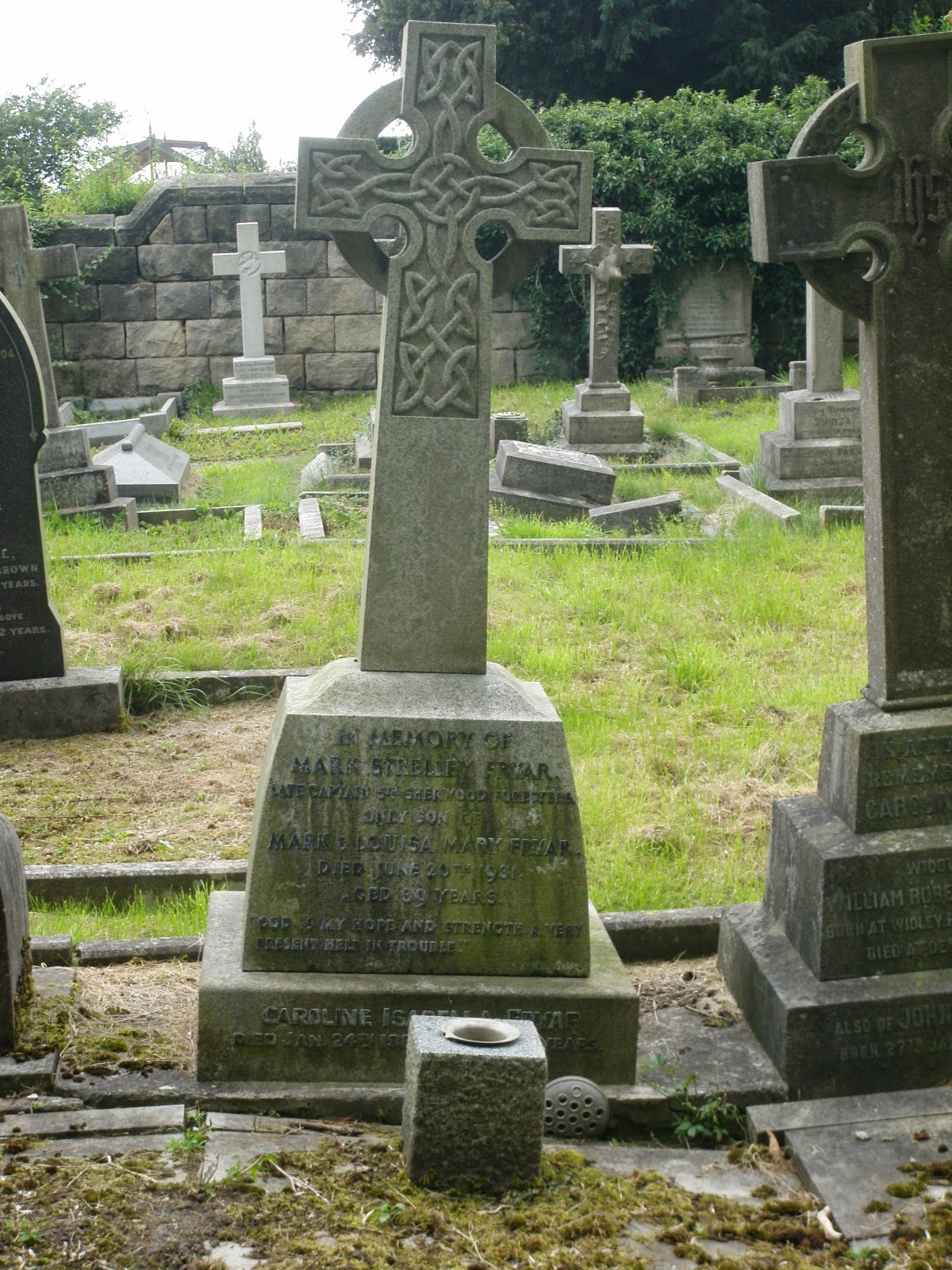
At age 39 in 1931, he died- a bachelor. He had been living between Long Bennington and Denby and after a visit to the pub was involved in a car accident while on a cycle. He died of head and internal injuries
He was buried with military honours.
| Notes from a talk given by Jill Sparrow to a local group |
Such a shame that, in hindsight Mark was probably suffering undiagnosed trauma. We now understand more about these war neuroses, probably initially caused by shell shock from his part in the Somme battle and exacerbated by barbed wire disease. Studies show that mortality rates of POWs in the 1920s and 30s were five times that of other veterans. An added cost of war.
Remembrance Day 2025
Lest we Forget
| Mark's grave in Denby with his sister Molly |
PLEASE CLICK ON ANY PICTURES TO ENLARGE
| Ewan Martin |
This Remembrance Day, I'm following up on some Strelley /Martin
relatives. My three-times great-grandaunt, Georgina Grace Greasley Strelley
married William Martin and ended up with three boys who had distinguished
careers as teachers or clergy.
Georgina Grace Greasley Strelley m William Martin
1829-1907 1838-1893
John Rundle
Martin + William Martin +
Alexander Moody Stuart Martin
1856-1921 1860-1924 1868-1921
I have previously written about William Jrs sons- William
Strelley Martin and Thomas Partington Martin’s distinguished careers. https://robynandthegenies.blogspot.com/2016/03/brigadier-william-strelley-martin-and.html
Previously Georgina’s brother who was my 2x great grandfather William Strelley was
a pensioned soldier who had served in the Crimean War. https://robynandthegenies.blogspot.com/2017/11/everyone-is-called-william-william_22.html
Georgina’s first son Joseph Rundle Martin,
Schoolmaster, Fowlis Wester, and his wife Jane (McEwan) Martin had five
sons. Military service was in their blood. Dad, Joseph, had previously served
in the Scots Guards. His older brother
William, was a career School Master and Joseph’s two nephews were enlisted enlisted.
Joseph’s sons were
William Martin 1886-1980
John McEwan Martin1886-1972
James Alexander Martin 1891-1951
Peter McEwan Martin (Ewan) 1897-2/12/1917
Henry Stewart Martin (Harry)1899-23/7/1918
The oldest of Joseph and Jane’s sons William Martin 1886-1980 was precluded from
signing up much to his lifelong regret. William Martin was a career school
teacher; he ended up being the principal teacher of maths and science at Pitlochry
High School and Bredalbane Academy, Aberfeldy. He died in Pitlochry in 1980,
aged 94.
| Henry and Peter Martin |
The other four chose to enlist in the Great War : these two would
lose their lives before the end of the war.
First to die was Captain Peter McEwan Martin1897-1917 ( known to his family as Ewan), 11th
Border Regiment who was killed in action, 2nd December 1917.
![]() |
| Peter McEwan Martin (Ewan) |
There is no record of his promotion to Captain, but it is
likely that he was promoted “in the field,” because of his leadership qualities
and heavy casualties.
Copies of letters he wrote to his sister in law Mary have survived. Initially he is upbeat about his experience and had seen his brother James several times as they are in the same division. They are both in good health. Weeks later they are in the trenches – the weather has turned and there is plenty of mud. “As long as one is in good health there is no reason for grumbling.”
By July 1917 he writes that he and James have both been
wounded. He was injured twice in five days but nothing too serious. All up he was wounded 3 times. His brother
James was injured and required convalescence locally – not back home.
![]() |
| Letter sent to Aunt Mary from the Front Aug 1917 |
As this August letter says he is a young Company Commander with perhaps more skill than the older boys- they will soon be off to action and “it will be up to me to pull them through.”
A MOONLIGHT
MASSACRE....
An Extract from “A Moonlight Massacre: The Night Operation on the Passchendaele Ridge, 2nd December 1917” by Michael Stephen LoCicero tells the story. A detailed account of the night attack can be found here - from "A Moonlight Massacre: The Night Operation on the Passchendaele Ridge, 2nd December 1917" by Michael Stephen LoCicero. P188
“With two companies in front and two immediately behind,
the 11th Border Regiment (CO Major and acting Lieutenant-Colonel T.F. Tweed,
MC) waited for Zero-hour along the 300-yard jumping-off tape. Silence was
maintained as the battalion ascended the gentle incline toward the summit of
Vat Cottage Ridge at 1:55 a.m."
"Confronting them was the anticipated collection of
occupied shell hole outposts comprising the Vorfeldzonelinie, the left-hand
portion of linear trench facing 16th HLI and, beyond the forward edge of the
Hauptwiderstandslinie and subsequent green line objective, the ramshackle
agglomeration of dugouts, shelters and trenches found, approximately 200 yards
south of the battalion’s final red line objective, in Mallet Copse."
"Another short stretch of linear trench, protected
by barbed wire and extending from Veldt Farm to Mallet Copse, had also been
noted by II Corps intelligence in the days leading up to the attack."
“The enemy remained quiet as the four companies of 11th
Border Regiment silently entered no man’s land. Sporadic rifle bursts –
immediately followed by a vicious fusillade and cascade of descending magnesium
flares – put paid to any hoped for surprise. Both front companies, resolute in
the face of fierce machine-gun fire, quickly swept over the Vorfeldzonelinie
and, topping the ridge crest, occupied the green line and seized Veldt
Farm."
"The two leap-frogging companies, passing through
the secured intermediate objective, rushed downhill to enter Mallet Copse at
its southern end. Bomb and bayonet made short work of any occupants discovered
among the haphazard warren of mined dugouts, corrugated metal-roofed shrapnel
shelters and narrow trench sections before the tiny copse was cleared and its
north edge gained. Any further advance from there through the muddy northern
valley towards the red line was stopped by machine-gun fire originating 200
yards northward from inundated Mallet Wood. Remnants of the leap-frogging
companies, their position now rendered untenable under a rain of bullets, fell
back to ‘the southern edge of the copse with their left flank refused"
“The 11th Border Regiment, notwithstanding heavy
casualties and resultant confusion, had been able to advance 500 yards and
occupy dispersal positions of the green line intermediate objective to – 200
yards short of the red line – Mallet Copse. This epic action by the ‘Lonsdale’
Battalion, was, as with other battalions of 25 and 97 Brigades, underlined by
many obscure human tragedies now lost to time.”
Although there is no definitive record of how Ewan Martin
lost his life, it would have been at some stage of this action.
The War Diary of the 11th Border Regiment states that
“Casualties included Capt. P.M. Martin along with other
officers”
Officer casualties for 11th Border Regiment were as follows:
Killed: Captains I. Benson, A.F. Sandeman,P.M. Martin; 2nd Lieutenants R.C.
Richardson, W.B. MacDuff. Wounded: Captain McConnan, 2ndLieutenants J.M. Jamie,
Fell, Hotchkiss, Malley Martin, Duff, Abbey. 34-year-old Captain Issac
Benson,33-year-old Captain Albert Fitzroy Sandeman, 21-year-old Captain Peter
McEwan Martin, 2nd Lieutenant Robert Cecil Richardson (age unknown) and
24-year-old 2nd Lieutenant William Brown MacDuff have no known grave and are
commemorated on the Tyne Cot Memorial to the Missing.
| Peter's obituary |
| Reprinted letter from Peter's Lt-Cpl |
His little brother, the youngest of the Martin boys, Henry
Stewart Martin1899-23/7/1918, also known as Harry S. Martin, was with the 6th
Gordon Highlanders.
![]() |
| Henry Stewart Martin |
On 23rd July 1918 the 6th Battalion was subjected to heavy
artillery fire and suffered numerous casualties on 23rd July 1918. Fifty-one
Gordon Highlanders were killed including Henry on that day alone. Henry was
just 18 ½ years old when he lost his life.
The Battalion Diary shows there was difficulty with terrain and training.
| 6th Highlander's War diary of the day |
Sometime after the 23rd of July Henry’s parents learned that their youngest son had been killed in action in France. His summer death seems to have come only weeks after he had finished his school career as he had enlisted during the spring. His death was recorded in the local newspaper.
| Henry's Obituary |
| Commonwealth War Grave - Henry is buried at Marfaux British Cemetery |
Henry Martin is also commemorated with his brother Peter on the Fowlis Wester Parish War Memorial.
| The Fowlis-Wester Memorial at the local Church |
It is noted that 165 former students lost their lives during
the Great War. As part of the Perth Academy remembers research project in 2014
students set about remembering the 168 former pupils and staff who lost their
lives in World War I.
The” Flowers of the Forest” Research Project remembered them during the
centenary of World War I. The current links for the research project on their
website are broken, but the war stories have been transferred to the relevant
people on the Commonwealth War Graves site. Peter McEwan Martin and Henry
Stuart Martin. Links are here.Captain
Peter Mcewan Martin | First World War Story | For Evermore and Private H S Martin | First World War Story | For Evermore story
The Great War Memorial in the school hall remembers the boys. Relative Sheila McMillan sent the school memorabilia she held for Peter McEwan Martin (Ewan). This is now displayed next
to the Roll of Honour. It includes medals, letters, and photos.
| Memorial at Perth Academy with Peter's (Ewan's) Memorabilia framed to the right |
One thing led to another, the Perth Academy put me on to the fact that Sheila had provided the information and that she had emigrated to Australia. I tracked her down via her ancestry tree and discovered we lived close enough to meet up. So recently, I enjoyed a coffee with my Australian fourth cousin looking at her copies of photos, letters, and comparing notes. Too busy talking, and sorry, no photos.
Back to the Martin family...
Poor Jane and Joseph Martin, their second son, killed for
service of their country. With William jealously at home, Jane and Joseph
nervously waited news of their other two sons.
James Alexander Martin, 1891 - 1951, is the brother
referred to as injured in Peter's letters. His service with the King's Own
Scottish, service number 22369, where he was an Acting Warrant officer, Second
class. His brother Ewan’s letters back home in the early days mention seeing
James once or twice over in France, that he had been injured and had
convalesced.
His obituary has him demobilised with a rank of Sergeant
Major by the end of the War and no other war records can be found.
After the death of his father, Joseph Rundle Martin in 1921, he continued with his financial
career and married Gladys Mallet. In 1929, he travelled to Canada and was an
investment dealer with WC Pitfield and Co. and wife Gladys and his son Peter
Martin, born in Hampstead in 1928, followed in 1931 on the Ausonia. They
lived in St John and Monreal.
When the Second World War broke out, he enlisted in the Active Army, in which
he served for most of the war as an adjunct to the 2nd Battalion, St John
Fusiliers, with the rank of Captain. Post-war, he was transferred to Toronto as
manager for Hugh McKay & Co, which a post he held to his death, dying in York,
Toronto on 20/2/1951. He was survived by
his wife, Mabel, an active Red Cross worker, and his son, Peter.
| James' Obituary |
The 4th Brother to serve was a career Soldier. John McEwan Martin
1886-1972 was the second oldest boy. By the time of his death he appears to
have been somewhat distanced from his remaining brother William who did not go
to war and of course his brother who immigrated to Canada. He had a
distinguished career as a professional soldier. The London Gazette lists him in
the 30th of March 1915 as temporary lieutenant. His war records cannot be
located. However, he has an interesting story and a very distinguished career
At the outbreak of the War he married Lanarkshire born Cecilia
Turnbull Anderson in 1915 in Lanarkshire. She had finished her medical training
in Glasgow. After the War ended the couple lived in London.
John signs the 1921 Census as Captain of the Royal Engineers.
He is 36 years old and an Analytical Chemist with the Ministry of Labour
Training College and she is a 36 year old physician and surgeon with the Public
Health Services of the Leyton District Council.
Later, he was promoted to Captain from 4 July 1922. In 1924,
he is with the London Divisional Engineer Corps of the Royal Engineers. She
died, possibly in childbirth, in 1927.
He married for a second time to Mabel Dickinson in 1935 in
London. Later, in 1937, John was promoted to Major. He was obviously involved
during World War II. (No records are available. ) Sheila feels he was involved
with research into flame-throwing technology and weaponry. Flame thrower incendiary devices were used in WWI and more widely in WWII as tactical weapons against battlefield fortifications and bunkers.
He was finally discharged in 1949 when he reached retirement age.
| John's obituary |
After this time, he married for a third time in 1960 to Edna
Muriel Leighton, and they lived together until John's death in 1972. His
obituary shows he received an OBE, possibly for military service. Edna died in
2000 in Nottinghamshire.
As part of the research into these war stories, I looked into Georgina's remaining sons and grandsons. William, whose two sons were career soldiers, died in 1924. His sons served out two wars.
Alexander Moody, Stuart Martin, who married Christina Williamson,
were missionaries who migrated to Montreal in 1911. Their sons William and
Henry were too young to serve in World War I. Son William died in 1924, and
Henry and his clan appear to have followed in the family religious service
occupation.
Meanwhile Joseph and Jane continued to live locally, Joseph
dying in 1921 and Jane in 1951. Their plaque
commemorates their two dead sons also.
| Jane and Joseph's tombstone |
I, myself have daughters who, for most of their life, have been safe from
enlistment. Two of them have grown up daughters now, who now would be called up
and would have to serve. The times have changed, and there'd be an expectation
that the women would be there.
I hope I never see this or my grandsons being called to
fight in another world war.
Thank you for your service, Martin family. Thanks for a job
well done.
Rest in Peace
We will
remember them on this Remembrance Day 2025.
| David Rowbotham and Cousin Cpl Leighton Rowbotham |
After I found the Rowbothams in Canada Found.... The Rowbothams of Ontario, one son, Alfred Rowbotham, intrigued me. There was much sorrow in his life. His parents died when he was young and then he followed his siblings to Canada to live in 1905. His marriage to Charlotte Grant ended in three babies dying as infants and poor Charlotte dying of TB a short while later.
I feel that he was sponsored to Canada by a rich uncle who was in the building industry in Warwickshire as there were plenty of opportunities for building in the expanding Canadian provinces and the US territories. As such he had contacts and opportunities in both countries and back home in England.
Next this young widower is found in England as a 33-year-old married to Margaret Robotham (nee
Scott) with a child, Peggy Grant Robotham, in the 1921 English census. Peggy was born
in Manchester in 1916.
![]() |
| Rowbotham family 1921 Census |
Reading between the lines, it seems Alfred and Margaret split at some time during his time in Toronto.
Further investigations show a marriage between Alfred and Verea Carr, previously Simmons. When at 40 years of age, he married on the 1st of March 1929 in Detroit, the marriage certificates states he has been married twice and now divorced and has no legal wife living. She is also a divorcee. This marriage lasted from the 27th of July 1929 to the 13th of October 1930, when final divorce papers were issued. They had in fact parted in April 1930.
Passenger papers show him in a 1930 border crossing from USA to Ontario to his brother's place from Detroit.
Next Alfred married another Margaret, Margaret M Adams in October 1933 in Rumford, Essex. A son, David Grant Rowbotham, was born in London on the 23rd of July 1934. They lived in London. It seems Margaret may have died in childbirth a year or so later. This is according to an article accessed regarding little David Rowbotham.
![]() |
| Alfred and David in 1939 Register |
This is backed up by the War time 1939 Register record, where Alfred and a
minor are living in London. Alfred is a widowed father. David was told stories by his
dad about living in Canada and of his extended family who had settled there in
the 1900s.
David's life was almost as tragic as his father's.....
A few years later, London and other parts of England were hit by the Blitz. The
Blitz was a surprise attack bombing campaign by
Germany and Italy during WWII for eight
months, from 7 September 1940 to 11 May 1941.
It was mainly a night campaign on London, Liverpool and other port and industrial cities.
At some time during the Blitz, David and Alfred's house/home
was hit. Details of what happened next are a little sketchy. It seems Alfred
was seriously injured, possibly killed, and/ or was unable to care for his son.
Records at the time are sketchy due to the carnage.
Newspaper reporting says that David was orphaned or considered as such. He was
taken in by Mr. and Mrs. Frank Taylor of Brighton Sussex, adding to the six orphaned children they
had already taken in, because of the London Blitz.
George was Alfred's older brother. Florence was ecstatic. She was the mother of 13, (10 living) children. Adopting one more was no problem to her. She had four grandchildren living nearby and was looking forward to taking in the son of her husband's brother. “This is a children's country and we know that David will be happy here” she said.
Peggy Rowbotham married in 1933 in Detroit. Her marriage too was short-lived, divorcing in February 1938. One child had resulted; George W. Day Jr was born on the 22nd in 1935 in Detroit and it wasn’t a happy marriage. It seems he may have stayed with his father. Peggy appears to have returned to England possibly with her father. There looks to be on a 1939 record with her pursuing a career in nursing.
She married Alexander McDougall in 1944 in Surrey. She
doesn't appear to have had any more children. Peggy Grant McDougall died in
1981 in Camden, Greater London. Due to the circumstances, she probably wasn't
very close to her little brother David, who came along after her father's
divorce from Verea Carr and his fourth marriage to Margaret Adams in 1933.
What became of David?
He moved to Toronto, married Vivian and had two children.
In 1950, he joined the Black Watch Army and was in Korea in
the early 50s. When he came back to Canada, he packed his family up and
followed Uncle Art (Leighton Arthur Rowbotham) and Aunty May (Martha Laing)
to Bakersfield, California. He died on his birthday in 2002.
He was a home repair handyman and personnel manager at the White Front Store in
the early 70s and a driver for Orange Belt Stage Lines for 10 years. At some
stage he changed his name to Rowe.
His obituary notes him as a member of
the Stein Road Baptist Church. “He had a servant's heart and left his world
after spending several days working on a church at the Eagle Mount Indian
Reservation.”
He was survived by his wife Viviann Rowe, son Brian, daughter Janet and
grandchildren.