Search This Blog

Showing posts with label #52Ancestors. Show all posts

Saturday, 9 June 2018

TWO BROTHERS FROM NUNEATON- The Story of John and William Gadsby


If they lived in Warwickshire today, brothers Billy and John Gadsby would have played football for the "the Nuns" or  "Boro" and would have been well known around the small towns of Nuneaton or Attleborough. This episode traces back to the earliest known stories about the Gadsbys in Nuneaton.  John (b1770) and William Gadsby (b1773) were the 8th and 9th children of the Gadsby family from  Attleborough in the county of Warwickshire.


Lets face it, John Gadsby senior (b1720) had enough children to form his own footy team! John my 4x Great grandfather had outlived his first wife Elizabeth Cope who died after producing his first 7 children. On 26/6/1770 after the reading of Banns at the Chilvers Coton Church the fifty year old John married for a second time to Martha Lingard who went on to produce at least 7 more children.


John was a road worker on the Attleborough/Nuneaton Road. Being poorly paid plus having a sizeable family saw the Gadsbys scrapping together and living in relative poverty. Nevertheless John Gadsby lived to the ripe old age of 96, dying in 1816 in Abbey Street Nuneaton.  He had fathered 14 children and outlived Martha by 8 years.

Amazingly, for a poor road worker many details of his life and the antics of his young family are known. It seems his youngest daughter Nancy was critical in providing information which was documented in a Memoir written by his grandson John (Son of William) upon the occasion of William’s death. Then aged about 60 and still living in the Nuneaton area, Nancy was able to provide information to William’s son about the family, children and  Attleborough in the early years.  This is the story of two brothers and the Memoir provided a starting point. 

John, their father, is said to have been a quiet man were as his wife Martha their mother was to have a reputation of being much louder as most mothers of seven children would be.   Presumably there were children still at home from John's first marriage to Elizabeth. (Eleanor, Elizabeth and Sarah plus 4 others)  Martha produced three boys John, William and Thomas (names which will be duplicated several times in future Gadsby generations) and a string of girls Anne, Fanny, Elizabeth and Nancy. Thomas the third son lived only a couple of months as was often the case in those times. 

John Gadsby born late 1770 is the ancestor/patriarch of our line. His christening records show him as John GADGBY baptised on 20/1/1771.   Gadgby is the provincial pronunciation of the name. His brother William Gadgby was baptised three years later on 17/1/1773.

As is often the case in large families, the boys were feeding and nursing babies as soon as they were able to sit up themselves. Their parents were so poor, education was out of the question.  The children were left to run about the village bare footed and in ragged clothes until they were old enough to work. It is known William received a meagre education -learning to read but not write at the Nuneaton Church School. Attendance was for perhaps 2-3 days per week.

The townships of Nuneaton and Attleborough were well known for their cottage industry of ribbon weaving the industry which was  introduced by French Protestant refugees. Weaving was mainly done in the homes of the workers.  Most probably Martha was supplementing the family income by operating a loom from home. While the children ran around the streets the people of Nuneaton worked on their looms beside long windows in the upper story of their homes. This allowed for maximum light and a good view of the children in the streets below.
A sketch from Ramsbottom's book of the Gadsby's Attleborough Home

Having plenty of time on their hands the two brothers Billy and John repeatedly got up to all sorts of mischief and pranks.  On a later visit to the village William told how they often they plagued  the life out of two prim and elderly ladies who lived in a cottage nearby. Eventually the ladies got their own back by drenching William with a bucket of water.


There is one story documented in the memoir about the two boys. It was during the time of the Nuneaton Fair around 1890. "We'll cut across this field to miss the crowds,” said John who was about 20 years old about this time. When they reached Attleborough he suggested that they call into the Three Crowns Public house to partake of some "Queen's cordial".  This is apparently no drink for the faint hearted. The recipe goes "take six quarts of Cherry Brandy, 2 quarts of sherry 3 pints of brandy, rum etc”. To this is added various herbs and spices.  Curious to try it young William bought 3 half pennies worth. Basically they did what brothers do and got horribly drunk together. By the end of the night William was begging the landlady for a bed. "No" she said, "I'll not have some drunken fellows here!" William never forgot that night. Apparently William did not drink liqueur very much forever more. He was so mortified he prayed all night for God's pardon.

About that same time John enlisted in the Warwickshire Militia and served in the regiment for nearly 28 years. The Militia had been established in 1757 as a type of home guard during the years of the Napoleonic Wars. As insufficient volunteers would come forward, a form of conscription was introduced in which each parish would make lists of adult males in the parish and hold ballots to choose men for “compulsory” service. All men in the parish aged 18-45 were included in the lists. “Drawn men” who were unwilling to serve in the militia had to find substitutes to serve instead of them.

It is unknown whether John was a willing volunteer, a drawn man or a willing substitute but Military service was probably seen as a stable income for a man from such a large and poor family.   The Warwickshire Militia was therefore a type of reserve army. At the time John enlisted (1889) most men only served for 5 years. There was widespread dissatisfaction with the balloting of young men. John served for a total of 25 years- his long service shows he clearly enjoyed the benefits of being a Militia man. John rose through the ranks of Private after nearly 9 years to Corporal for just over 4 years and to Sergeant for a further 11 years.


John Gadsby's militia service
In tracing the history of the militia it seems most likely that men lived at home during peacetime and that they would have spent time away from home only when on training camp.  During the Napoleonic War 1813-14 however men were placed on permanent duty. At this time his Militia records indicate he was a “Sargeant”. Military websites indicate Militia men did not serve overseas. However parish records show that while men were on permanent duty wives and families were paid allowances.  

Therefore John was a Militia man when he married his first wife Elizabeth Smith on 20/11/1897. The marriage lasted a short 6 years as Elizabeth died in 1803. There are no records of offspring from this marriage in the surrounding Nuneaton parishes. A little over a year later when he had been promoted to Sargent he married Mary Brown in December 1804.  This may have involved being involved in training of younger recruits or even relocation with Mary to another Parish. His longer absences away from home may explain the lack of children recorded in the local Nuneaton Parish records.


By 1814 John had left the Militia as a consequence of age and infirmity to return solely to his trade of ribbon weaver. At the time of his discharge his Militia papers describe him as grey haired with grey eyes and sallow complexion. He was a reasonably tall man at 5 feet 9 ¾ inches. 


The only recorded offspring of his marriage to Mary was Damaris who was born some while later in 1817. Unfortunately the life of Mary Brown came to an end 5 months after the birth of her daughter. In what seems to be a bit of a tradition with Johns in the Gadsby family he married again.  Within 6 months the banns were being read for the marriage of 24 year old Elizabeth Harris and John Gadsby. In June 1818 they were married. John was still ribbon-weaving most likely from a room in his home. At the height of demand for these highly decorative ribbons, ribbon weaving was the town’s main industry and weavers could earn good money.  


John and Elizabeth went on to have 5 children, four of whom (2 x Rebecca, William and Martha) died in infancy. The only surviving child was our John who was born in 1826. He is first recorded in official documents in the 1841 census as “Jno” living in Hall Row with his half sister Damaris and her family.  He was working in the family trade of ribbon weaving.


John and Damaris’ father, John the Militia man had died in 1833 when John was seven. His mother Elizabeth appears to have married a widower from the nearby Chilvers Coton, a hamlet of Attleborough. She and Thomas Clews had a couple of short years together. They married in 1836 and the 1841 census shows her living by herself as a ribbon weaver in Freer’s Row, Nuneaton not far from where John and Damaris were living. Freer’s Row was a narrow and very short street. Her neighbours were the Freer family a family of ribbon-weavers after whom the street was named. Her death is recorded as 1842.
John lives with Damaris and family in 1841 while his mother lives in a nearby street.

So John, the thrice-married Militia man,  and ribbon weaver lived to approximately 63 years old. What became of his only brother William? Why did his son see fit to write about William and the Gadsbys in a memoir which has survived until this time?

Life must have been hard for the growing Gadsby family. Plenty of time on their hands, little education meant they could get up to mischief but this was matched by a weekly dose of wrath and condemnation from the local clergy. William had serious thoughts about sins and God while still at school. Racked with guilt about stealing turnips from the field or his swearing and pranks , he would be regularly determined to reform and to be a good boy.  On one occasion he decided to run away from home. Feeling sorry for himself he disguised himself by stuffing old rags and straw down his back to look like a hunchback. An anxious John and Martha dismissed the sightings of a hunchback boy of similar age saying “O No, that could not be our boy.” 

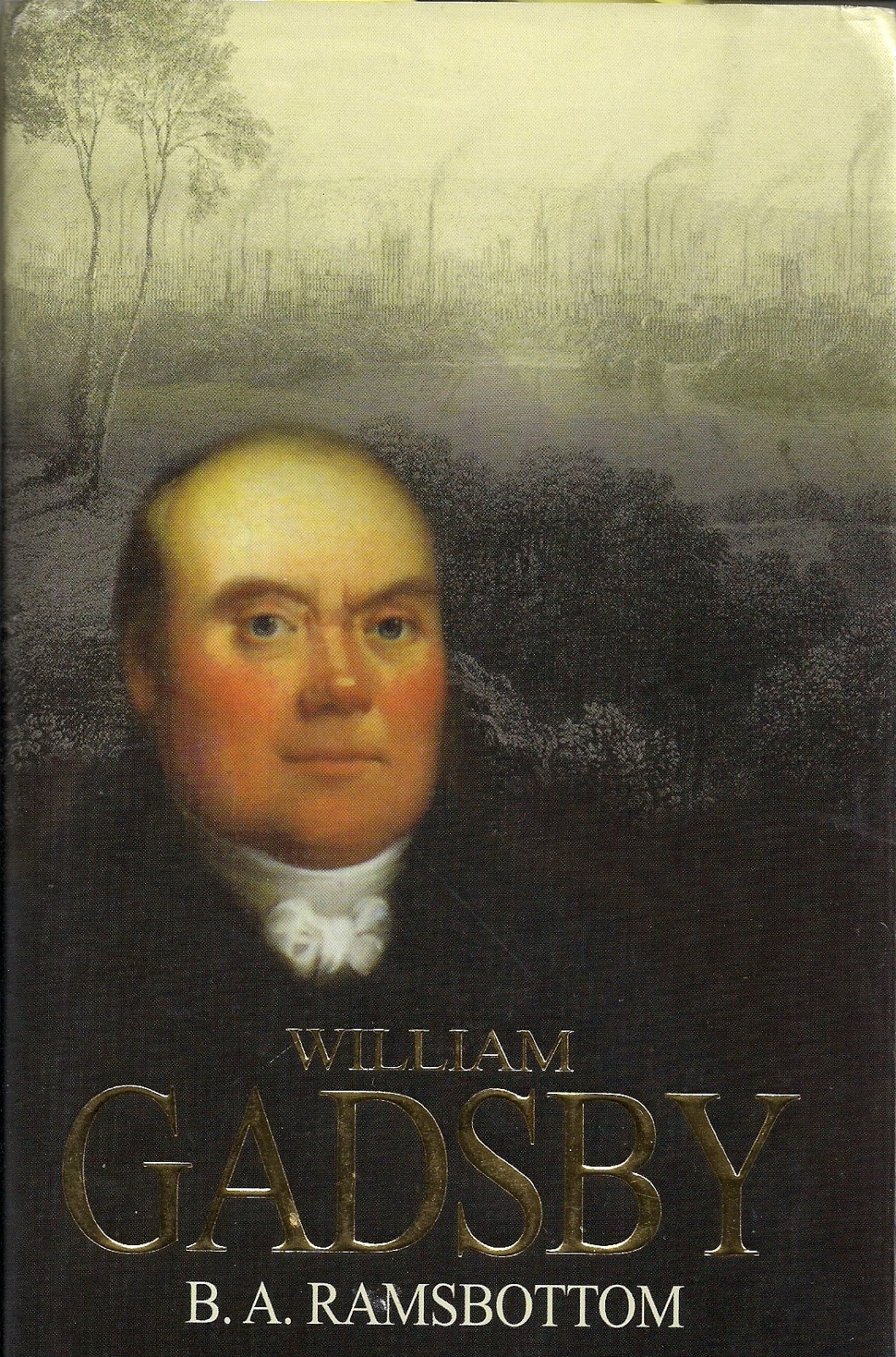
As soon as children were old enough they began working on looms. At the age of 13, William was apprenticed for 5 years as a ribbon weaver to a Mr Copson. He was allowed to keep half of what he would earn from weaving.  Even then he still got up to all manner of sin and folly and it bothered his conscience. However, Ramsbottom in his book on William Gadsby, 2003, describes him as “a born leader, friendly, humorous and popular”. In the workshop he would hold forth for an hour at a time on an old tub to fellow workers making them roar with laughter. Once when he tried to leave the employment of Mr Copson his fellow workers complained so bitterly that he returned to work there.

He attended the Independent Church with his parents and later he attended a church at Bedworth.  He spent so much time trudging backwards and forwards to Bedworth that he and his mother Martha quarrelled. “O Billy, “she would say “You’re off again!” It wasn’t the fact that he was off to church so much as he only had one pair of shoes and his mother worried that unless he went barefoot his shoes would get worn out.  “Never mind, mother” he would say, “I shall be able to keep you yet.”

He eventually joined the Baptists at Coventry and was baptised in late 1893. Mr Aston who baptised him said “he could see something in the young man, although so illiterate and uncouth, that seemed blessedly to prove that he would some time or other be made useful to God’s dear family.” He trudged 8 miles each way to attend the Sunday services. It was during this walk that he composed the “8 Mile Hymn” one of his many. The experience of the drunken night with his brother John and witnessing a hanging of three young men in Coventry had profound effects on William when he would eventually become a preacher.

After meeting a girl named Elizabeth Marvin she persuaded him to give up ribbon weaving and take up stocking weaving in the nearby town of Hinkley.  They married on 16th May 1896 when he was twenty-three and she was twenty-five.  Having set up home in Hinkley the first of his children Rachael, Sarah and Phoebe were born. Here he became a preacher using the old barn at Hinkley and then building the Hinkley Chapel.
Church built by Gadsby  at Hinckley c 1803

Later he moved his young family to Manchester where his other children Ebenezer, John and William were born.


Here, he was a Minister for 38 years, widely known and respected as a remarkable and passionate preacher who had “a gracious effect in the hearts of men and women.” He championed the cause of the poor, especially over the Corn Laws. He is well known for the many hymns that he wrote some of which are still in use today.  His influence also came from his publication of the Gospel Standard magazine that he set up and which is still published today. He was the founder of  many churches, which spawned the term “Gadsbyites” in the 1820s.  A.C.Underwood in the “History of the English Baptists” described him as “a pulpit genius” and his great friend J.C.Philpot  said of him “he spoke with such power and authority that it seemed almost as if he had been in the third heaven.”

William Gadsby (npg.org.uk)

This great son, father, husband and preacher did not return to Nuneaton very often due to his commitments to his many Churches in Manchester and surrounds. It is known that he took the funeral sermon at Attleborough for his mother who died in 1808. When his father John died at the age of 96, he penned a poem of 15 verses “On the Death of the Author’s Father” (Nazarene’s Songs No 175) in hope that all was well with him in the hereafter. 

It is documented that he was always a little stretched for funds for his preaching and good works but that the Lord always provided. He was used to being poor and with his family of 6 children he had many providential difficulties as his income did not support his family let alone other projects.  Gadsby always believed that “My every need He richly will supply.”  Later when he received funds in praising God he would preach  “He has heard my prayer and helped me, and I will trust Him as long as I live.”

William's son John documented his life in"A Memoir of the Late Mr William Gadsby" 1844 
William died in 1844 in Manchester. His wife, Elizabeth died  in 1851 having suffered from debilitating mental afflictions for over 30 years.  His children Phoebe and William immigrated to the USA. Sarah, Rachael and Ebenezer married and stayed around Manchester having 17 children between them. John in (what appears to be a trend amongst Johns) married three times and continued his father’s good works by editing, authoring and publishing religious works. He wrote the “Memoir of William Gadsby” upon his father’s death in 1844 and as a result of this we have been able to  picture our Attleborough roots .   

A treasured copy of Gadsby's Hymns 

One little lasting memory of our relationship with the famous preacher occurred when Thomas our great grandfather came to Australia in 1912. His brother John gave him a Gadsby Hymn book when he was leaving- a lasting reminder of our Nuneaton history. Thomas who told the story of bringing it to Australia to his children and grandchildren treasured this hymnbook and reminder of home. He, having little else to give passed it on to his oldest grand-daughter, Betty for safe keeping and our heritage has been in her safe hands ever since.    
I like to think this street in Nuneaton is named for us all.

There are two streets in Nuneaton visible from the train. William Street and Gadsby Street both named in honour of their famous ex-resident, William the preacher. I like to think that William Gadsby shares the honour with those who lived there too and the generations who came after  – the humble, honest townsfolk who went about their business worked  hard and  served their country. They also bore the “famous” Gadsby name.

Acknowledgement:
I have received much help from complete strangers in researching this part of the history of our family. BA Ramsbottom’s book was invaluable and he has tried to put me in touch with others researching Gadsby relatives. He is still heavily involved with the Gospel Standard originally set up by William. Some of the pictures have been supplied by him.
Peter Lee from the North Warwickshire Family  History Society has also been of assistance. He lives in Attleborough and has volunteered to take me on a tour of the town hopefully sooner rather than later. His family developed some properties on the famous Gadsby Street.  Peter provided me with the first article on William the preacher when  I enquired about Gadsbys living in Nuneaton in 2010.
We have befriended Chet Gadsby in the USA who has numerous records of Gadsby births, deaths and marriages- he claims their purchase of them as religious tax deductions! Thanks Chet.
My partner in crime , Leane Lawrence has been a great  little researcher sifting  through Parish records and keeping me posted on her many finds in the family tree.  

For more information on Gadsby’s hymn’s there are  free copies  in e- book format  or PDF on the internet. John Gadsby’s Memoirs of William Gadsby and  some of his own writings are also available  as PDF or e- book for free.

If you search William Gadsby on Youtube you will get a couple of his famous hymns set to modern music. Here's one  Gadsby Hymn

At first glance we thought we had nothing to go on except a hope that we might find someone famous in our tree and that we might be related to this preacher whose hymn book we had and who had the same name.

So in answering   “Who do you think you are?”  I think we came from pretty hard working and honest working class people- something to aim for.

Should you find any more information or if you have any questions please email me 

More stories in this series 


#52 Ancestors "Going to the Chapel"

Monday, 16 April 2018

Talk to the ones who will be ordering the skip bin


How many times have we seen the skip bin delivered to the deceased estate? The family descends and makes quick work of clearing out the house for sale.

In our case it was three bins, many many car loads, garbage bins and trips to charity shops. I’m not saying it isn’t a big job. For us it was a labour of love and we had been told that we needed to look out for some valuable coins. I think this was a ploy dreamt up by my father and the next door neighbour.

Our sons in law have already said that all the stuff my husband is putting in the loft lift is going to skip (some of the stuff already belongs there! The boys should be encouraging him to cut out the middle step)

Hint: label important belongings

When we cleaned out my Dad’s house we made a picnic of it.  All the family was involved.  Any coins we found (but not the valuable ones) paid for lunch and any helpers could keep whatever they wanted. We laughed about items and memories and I'm sure the grandchildren were well aware of the history of the ornaments, jewellery, paintings etc.

Seven months later after fortnightly visits we completed the job. Only then did I start doing Family history and in talking to relatives suddenly realized the long term ramifications of what was done. For example this comes to mind. My aunt mentioned that “lovely” jewellery box my mother had on her dressing table which came in the trunk from India after my uncle returned from the war. None of us liked it or knew of the reason mum had it and we sent both the jewellery box and trunk to auction. It made  $350+.  To find the provenance of it so late in the piece really made my stomach churn. Luckily a lot of papers made it into “the family history box” for further evaluation.


As you’ve seen from many of my family history blogs many of the photos and information have falling into place. Some of it gets pulled out from time to time and another piece of the puzzle makes itself known.


Heaven forbid I’m not suggesting you fill your house with another household’s junk. I personally hate houses that become a shrine for the dead mother-in-law or granny or are full of dead people’s furniture and belongings. I’m just warning you to take time and ask questions.

Some might say “I thought no one would be interested”.  Meanwhile others young and old may never forgive you for tossing their heritage. Knowing what I know now I’d be extremely disappointed to have lost so much. Remember there will probably only be one copy of grandmas photos and how many children, grandchildren and great grandchildren did she have?  Someone will be interested.

It's a bit horses for courses. Some view paperwork and trinkets as hoarding or a sign of disorganization. I say work out the person most likely to be the family archivist and historian and ask them to become custodian or at least ask for their advice. At the very least whip a few things through the scanner and email the documents before you hoik the papers.  I’m so glad I didn't throw all our priceless and irreplaceable photos. In our haste to finish the job, important not necessarily valuable stuff gets destroyed or boxed away before the interested person gets to lay eyes on the treasure trove.

I’ve worked in an op shop – people are ridiculously hasty. They can’t comprehend why grandma had a tablecloth with embroidered initials on it. If only they’d known  that it was carefully crafted by a long gone Sophia who tirelessly worked on her hope chest item in the early days of the colony. Perhaps their stomach would churn if they knew its story.
My great uncles fob - my brother wants to sell it!

So, I say talk about the items of importance in your household, be guided by the reason your Mum or Dad kept an item from his or her parent’s estate.  Look for the paperwork that backs up the value of the silverware or the banjo or the notes which say “Keep this” or “This came out from Scotland”.  These are future heirlooms.

The old record player in my grandfather's lounge room and a shell that was treasured

The mantle clock, Scottish ornaments and the china cabinet
As I wrote this piece I was scanning some photos of my grandmother’s house for a friend.  The photos are pretty blurred but I can see the two Scottish Highland fling ornaments that were Nanny’s. After she died they lived in my father’s house and now my brother’s.  The old record player was replaced several times over. I’ve got the mantle clock but the lovely curved glass cabinet … gone to auction. You can’t keep everything including the old piano that every grandchild fought over.  No one played it … not even Dad who it was bought for in the 1930s. 
No "heirlooms" in sight in this old house

#52ancestors


Thursday, 8 March 2018

Feminist ? Maybe but definitely a woman before her time….


Marlene Jewel Kerr’s Bachelor of Arts degree was conferred in May 1958. Remarkable because in those days it was  unusual for woman to undertake degrees unless they were rich. It was even more remarkable because she had paid her own way to do nighttime studies after the death of her mother in her final year of school and because for the last two years of study she had a husband and two small children.


We made it more difficult for her to attend lectures and she pleaded with the lecturers to allow her to complete some subjects from home. Marlene had always been surrounded by strong, motivated women: her Aunts Lena, Maude, Kitty, Grace, Edie, sister Airdrie and single mother Julia. Some of that example, faith and encouragement paid off.

 
Despite the handicap of kids and a husband she did it!


She taught briefly after graduating at Dover Heights Girls High School until her mother-in-law died prematurely leaving her without a babysitter – career on hold.


Marlene was born on 23/2/1935 to Frank and Julia Kelf who had both arrived in Australia in early 1910s. She started school at Woollahra Primary School and continued there in an opportunity class throughout primary.


From there was she was able to go to Sydney Girls High School. She was talented and loved to draw and paint like her father. There was quite a break between and her older siblings so to amuse herself she painted in water colour the sketches in her reading books. She liked to play hockey and enjoyed ice-skating with her friends. Like all teenagers she loved listening nightly to her favourite singing stars on the radio. For her it was the handsome dark haired Mario Lanza and Al Jolson “toot toot tooting” on the radio.


She gained good passes in the Leaving Certificate which allowed her to begin a university degree. As her mother was dead and her father was not wealthy she started work not as a typist but as  a clerk in the Commonwealth Public Service studying her university course at night. This is where she met her husband to be around 1954. She married Alf in 1955 and after the birth of me and my brother she continued to study until she graduated.


Mum was an avid reader and was inspired to volunteer at my brother’s Marist Bros in the library. After being goaded by me (age 13) for wasting her degree or perhaps it's because she needed to keep her brain busy she sought out a way to do librarianship by distance study and exams.


Determined to gain her qualification and with now three children she read through the required reading list, studied and sat exams. Finally in the mid 60s all her work paid off. Coincidentally a squash buddy of my Dad’s happened to find out about her studies and offered her a job at a Catholic Demonstration school in Dundas where he was the Principal. Again she was a woman before her time when she became “a working mother”  Mum coped with everything that came along- expansion of the school to high school then Senior School and transitioning to co-educational.


As the school grew and expanded she oversaw the various renovations and rebuilding of the library resources and facilities. Marlene and was responsible for the design of the Brother David Cunningham Resource Centre which at the time was argued to be the best in the Diocese of Parramatta. She took on leadership roles in the Catholic Librarians Group. She embraced new technology and was the resident Audio Visual expert at the school. A lover of local history she began to archive the school’s Marist History. Marlene was Careers Advisor, sports record keeper and introduced the new OASIS System of library administration at a time when PCs were only being introduced and in early days. Thousands of staff and students benefited from her professional and caring manner and her organisational skills and reliability was much appreciated.
Marlene at a work function


On a personal level she threw herself into the community. In 1961 she had moved to Carlingford with the family and became involved with the three schools we kids went to, our new parish of St Gerard’s and neighbourhood social activities.


That led to being an integral part of the Carlingford Camping group at Empire Bay. Many times she was sporting a paintbrush as part of working bees at the historic house. Many weekends and holidays were spent with family and friends. She had inherited the artistic gene and showed her creativity in her sewing, craft, calligraphy and cooking. I might add that she had a devious sense of humour and a video camera to back it up!


The love of history and the Video camera also came into play when my husband introduced her to a genealogy program in the 1980s together with a blank family tree. Archiving and technology were combined and she organized and recorded the family photos, videoed relatives and recorded their stories. What a treasure.


Unfortunately her preparation for retirement to travel the world and paint were cut short when she died of cancer aged 57 in 1992.


She only had enough time to influence and role model to three of the nine grandchildren. Nevertheless her three children Robyn and Paul and Helen had learnt enough to influence the rest of the grandchildren.  She would be really chuffed to see her granddaughters working in non-traditional careers and the feminist side of her would love their choices. She’d also love that they and the great grandchildren adopt the newest in technology for working smart and the creativity it inspires.
Granddaughter Erin overcame the odds to learn to drive forklifts at work


Happy 2018 International Women's Day Mum xxx


Wednesday, 7 March 2018

Do you have a favourite photo?


This photo now lives in the "family history bedroom". I stare at it every day.

Actually it captivates me.  It is quite possible that I knew it as a young child as it was more than likely hanging in my grandmother’s old flat  where I spent my early years.  It's large, stained and watermarked. When it was found it had probably spent 40 years lying flat in the top of a wardrobe hiding amongst the Kerr photos.

It's obviously been displayed in large frame at some stage. Perhaps it belonged to the bride? It took me a while to even know which side of the family came from until my eagle eyed husband spotted it in a video montage my mother had put together in the 1980s. So it went from the Kerr pile to the Gadsby pile of photos.  A little later cousin Wendy identified everyone correctly having known each of the characters.  It was taken at the wedding of my Great Aunt Selina (Lena) Gadsby 1890-1954 and Alexander Thurlow 1888-1962 in Balmain in 1918.

For the first time I was seeing my Grandmother Julia 1903-1954 and my great grandmother Selina Gadsby nee Smith 1869-1935. Young Selena aged 28 married Alec aged 30.
l-r Maude Gadsby, Robert and Alec Thurlow, Lene Gadsby, Selina Gadsby, John Robert and Julia Gadsby

The story is that Alec was a fellow travelling to Australia with his brothers; he met Lena who was travelling from London to Sydney on the “Zealandia” with her 4 sisters, baby brother and mother in 1912.  They were to meet up in Sydney  with her brothers and father Thomas as they were travelling by different transport. Lena had left behind her fiancé, Ben a butcher in London but had many weeks to while away the time on the journey.   Lena struck up a friendship. Alec and his brothers were lifelong friends with the Gadsbys when they landed in Sydney.  

Mother Selina though was not happy about the friendship and dispatched letters to Ben back in London to make haste to Australia.  Details about Ben are a little sketchy but he did come to Sydney at some time later in the next  few years. In a strange turn of events Selena Sr ran off with Ben when he arrived in Sydney and literally set up shop with him a small goods store in North Sydney.  Another little Gadsby child had been born – Edith in 1914.

With Selina taken off with Ben it was left to her daughter Lena to care for the baby and other siblings  before she eventually married Alec in 1818. Dad, Thomas Gadsby with his eldest’s help had been holding the household together, working as a bricklayer to keep the wolves from the door.

It is an incomplete family photo as several of the family is missing. To me Selena, my great grandmother looks like she doesn't belong. Is it the dress?  At first I had assumed she was a maid. She’s standing at the rear behind the bride and the groom who is seated.  They don’t look entirely happy to be lining up together for the shot. Julia a shy 15 year old, my grandmother is standing to the right. In three years time she will be a bride herself.  Her older sister, Maude Rose, 18 is seated on the left. Alec had his brother Robert Thurlow (standing) as his groomsman- you can see the resemblance?

Seated in the front is Selina’s brother John Robert (Uncle Jack).  At only 20 he looks frail. When Cousin Wendy describes him she says he's just back from the war- gassed in France- but his war records show no sign of gassing. Rather he seems to have suffered from shellshock and in this shot he looks a little haunted.

Missing from the photo is Thomas Gadsby, Lena’s father. Sadly a rare chance of a photo missed- we have none of him. Within a few years all of the older children will have married but sadly this is the only wedding photo.

Also missing are brother Harold and Thomas who have been away at war.  The littlest children are not included in the shot-Kitty, Grace, William and Edith. They were probably too young to attend the wedding.

Since I started doing family history the photo with its stained backing stands on an easel over looking (supervising?) my research desk. It accompanies me on my family history journey.  Naturally it was the theme photo of our 100 year Gadsby family reunion. Other family photos of the small children didn’t come to light until years later so this is truly treasured.

It's a moment in time captured for what it’s worth – a partial gathering of the clan whether they liked it or not. I'm so glad to have it and for a while it was the only childhood photo of my grandmother.
Taken a year so so later some of the missing siblings got in the shot
l-r rear to front Harold, Frank Kelf, Kitty, Maude, Julia and Grace Gadsby c 1920

Alec and Lena were well off, owned their own business and own home. They ran a toilet towel business-Hygienic Towel Supply which later became the Snow White Towel Company. Occasionally the nieces were employed. Alec and Lena had no children but often gave their spare rooms to those in the family in need of a place to stay.

I never knew Lena or Julia. They died in 1954 the year before I was born.  This shot of them laughing and playing with my cousins looks like a much happier shot. Perhaps it's a few little squirming cuties that is missing from the wedding shot above. 
Julia, Jillian, Lena and little Airdrie c1952