Search This Blog

Showing posts with label McConnachie Family History. Show all posts

Sunday, 3 November 2024

The McConnachies were an early genealogical brick wall for me 12 years ago.


Finally found them in the 1911 census

The McConnachie's were an early genealogical brick wall for me. They were a Scottish family, much loved and somehow, we were related.

Working out the clues

I had the clues and a copy of a reply to a mystery inheritance letter. The McConnachie's surname  had come up in many conversations my dad, his father and uncle had had during my childhood. No names of the individual people. In fact, the mother was always referred to as “Mrs McConnachie.”  A 1970 letter from a solicitor in Scotland asked for details for the extended family.

They were duly provided by my great uncle Alf in elaborate detail. But the reply gives no detail about the individual family members of the McConnachie family. Solicitors were looking for the next line to inherit from an intestate John McConnachie who died in Glasgow in 1972. Who were these McConnachies and how did they fit in exactly and did we inherit?

John McConnachie

Annie McConnachie

When sifting through the papers my father left in the 2010s, there were other mentions. Letters my grandfather James had written during his return trip to his homeland Scotland after retirement in the 1960s. Some photos signed Annie and John were identified by a relative as Mc Connachies.  A wedding photo with William McConnachie from my great uncle's collection is soon cross referenced with my great Uncle Frank’s wedding documents – he was a groomsman.

Frank and Katies Wedding - William McConnachie seated

There certainly was a close relationship. My grandad had especially visited them when he went to Scotland to thank them for looking after his mother in her dying days. The belief was that Mary Ann Kerr was the first cousin of Mrs McConnachie. It seems the McConnachies were very close to our Kerr family though due to Mary Ann (nee Murphy) Kerr's closer age and the closer ages of the Kerr boys and the McConnachie children.

The mystery letter.

It is the greatest gift to someone tasked with doing the family history. My great uncle had written back in reply to the solicitors. He detailed my immediate family and other relatives who migrated to Australia in the 1920s and the family of Elizabeth McBride, still in Scotland, who it seemed were all involved in vaudeville in Scotland with stage names to boot. The solicitors would have had fun trying to unravel that.

They were all related to my great grandmother Mary Ann Murphy nee Kerr. However, these McBrides and the Kerrs were related to John McConnachie as well. I just needed to locate the family and the parents.

I struggled to piece it all together with modern technology of Ancestry Scotland's people and newspaper archives. How did the solicitors do it all in the 70s?

Building the family tree. The 1911 census sheds some light.

Firstly, I had to work out who the McConnachies were and where they actually fitted into the family.  There were a lot of combinations of Johns. Eventually I found that William was a groomsman to Francis Kerr and a photo in my Dad’s possession showed there was a sister Annie. Several attempts later I found the 1911 Scottish census which told me the names of the parents (Mary Ann’s cousin) were Annie and David. Through sourcing her marriage certificate Annie was nee Blackwood.  Then I worked out her parents. From there I could backtrack through the Murphys and the Blackwoods to my great great grandparents – the McNamaras.  At last, I could fill out the family trees and most importantly the individual members of the McConnachie clan.

                                James McNamara married Jane Henderson.

I

I

Children were Elizabeth McNamara     +             Anne McNamara      +    Alexander McNamara

Married:

Michael Murphy                             John Blackwood

Children:           Elizabeth + Mary Anne Murphy           Annie.  

(First cousins)

 Married :     C McBride              James C Kerr           David McConnachie

Children :    various                    James +Alfred+ Francis Kerr  William+Annie+ John McConnachie (second cousins)


In summary : The common ancestor was James and Jane McNamara, whose children were Elizabeth, Anne and Alexander. The McNamara family of James and Jane were nee Henderson. had a daughter, Elizabeth McNamara, born 1835 in Ireland. She had arrived with them in Scotland sometime before 1845, when Anne and Alexander McNamara were born. Of his children, Anne, 1845-1917, had married John Blackwood. Her daughter, Annie Blackwood, had married a sheet metal worker, David McConnachie, in 1899, resulting in three living children, John, Annie and William, the second cousins to our Mary Ann Kerr's children.

So, with the handy relationship calculator, it seems that Great Uncles Alf Kerr, and Francis and my grandfather James were second cousins to the McConnachie children. The McConnachie's had lived in several locations around Glasgow, namely 390 Argyle Street, Buchanan Street, Dalcross Street and Lincoln Avenue. The 1911 census tells us of the McConnachie children 5 in total had been born, two dying in childhood.


The next available information was the 1921 census.

1921 census


A recent update of the family came via the newly released 1921 Scottish census. David and Annie were in their mid-40s and the children were beginning their careers or about to. David was a tinsmith, sheet metal worker at D. Rowan & Co. Engineering Company in Glasgow and remained so until his retirement and death aged 78 years.

His son William was a sheet metal worker and daughter Annie was a sewing machinist. John was just completing his schooling eventually becoming a sheet metal worker.

The McConnachies were sad to see the Kerrs leave for Australia in the mid-1920s. Mary Anne and her cousin had kept in touch while in Australia. When Mary Anne decided to return from Australia to Scotland in 1927, she returned with her son Francis (Frank). They both stayed with the McConnachies back in Glasgow.

 The matriarch of the household, Annie, nursing cousin Mary Anne during her final days with lung cancer at 10 Buchanan Street where she died on the 11th of August 1927. Francis Kerr continued to live with his mother's cousin and his second cousins until his marriage to Catherine Tolland in 1930. William McConnachie was the witness to the marriage. By then they were living at 10 Dalcross Street.

While the senior Anne's children worked in traditional jobs such as sewing machinist and sheet metal working, her cousin's children had a much greater range of jobs. Alfed was a welder at the Singer factory. James, my grandfather, and Francis Kerr, worked for George Green Ltd (picture houses). Francis had dabbled in music hall comedy. Dad’s cousins Ann and Mary Kerr, own a theatre poster where great Uncle Frank was billed in a variety act (a Hebrew comedian) at the Palace Theatre in Lawn St Paisley in 1923. Frank went on to become a Cinema/ Theatre manager and sadly met an early death on Christmas Day 1953 because of an accident at the Cinema. Francis was a cinema manager entertaining famous movie people. Sadly, he died childless in 1953 from a fall at the Bedford Picture House. The McConnachie's were devastated when he died. 

Frank Kerr on stage with Herbert Wilcox (l) and Anton Walbrook (r)

Frank and Katie entertaining at an opening

The McConnachie's other second cousins, i.e. those children of Elizabeth Murphy who married Cornelius McBride, were mostly involved in Scottish Music Hall. They were much loved comedians, singers, dancers and performers. Scottish music hall was a great source of fun and entertainment. The cousins under stage names Jeannie, Neil Power, Jimmy Finch, Oliver and Mac, and Arthur McBride mostly performed comedy skits in variety shows and they toured around Scotland and UK.

The theatres of Glasgow were always filled with knockabout humour, Scottish songs, music, comic scenes and skits. They were a fun family to be around.

Access to the Scotland’s Peoples marriages confirmed none of the McConnachie children married or had families. They corresponded with the Kerrs in Australia and exchanged photos. They would have informed us here in Australia when William died aged 52 of a cerebral haemorrhage in 1956 and Annie after retiring had died of coronary artery disease aged 67 died in 1969. 

A later photo of Annie and John sent to the Kerrs

Alas, the last child standing, John died of lung cancer and intestate aged 65 in 1973.

At this time, it was my Great Uncle Alf in Bondi New South Wales Australia who was contacted by the solicitors to ascertain the remaining relatives who could potentially receive the inheritance.

  The second cousins reunite

In 1966 my grandfather, James, retired and took an ocean liner trip to his beloved Glasgow. On his list of things to do was a visit to the remaining McConnachies to thank them for looking after his mother. Although Mary Anne's cousin Annie Sr had died in 1952 and David in 1954, he still wanted to acknowledge that the McConnachies had cared for his mother and housed his brother until his marriage. It had been a long time since he had seen his three second cousins and he was a little taken back to see them aged and one of them bedridden. Even so, he fulfilled his wish to thank them.

When James visited and Alfred in following years, they saw the transformation of Glasgow. Some traditional industries had declined and tens of thousands of people were moving into new housing estates and on the city outskirts away from the slum areas of their youth. Glasgow had been one of the most important industrial areas in Britain.

The solicitors in search of succession to the estate.

So, when John McConnachie died intestate, the search was on for the nearest of kin. The solicitors wrote to the Kerrs in Australia to ascertain details. The solicitors would have been hard pushed to trace all the Music Hall artistes with their myriads of stage names without help from Uncle Alf.

However, for me a copy of Uncle Alf's reply has been most crucial to my family history research 40 years later. In the end, the confirmation that the McConnachies were second cousins to the remaining Kerr's and McBride's family members. The investigation brought me closer to identifying John and Annie whose signatures were in the unlabelled photos in my father's collection. I've enjoyed revisiting the McConnachie's for this story and their movements around Partick and comparing their lives with those of their second cousins.

And now to the bad news….. The letter my Great Uncle Alf wrote off to the Glasgow solicitor outlining the relationship of the McBride’s, the Murphy’s and the Kerrs to the late John McConnachie amounted to nothing.  A closer relative was found. I actually came to the same conclusion but I was overjoyed with my findings. I am guessing it was the Blackwoods who got the money as they were the closer relatives. Perhaps it was even some of David McConnachie’s family.

The research into Lizzy McBride and her tribe of performing McBrides continues….Thank God for the information in the letter.

Here is the letter that started it all off. 


Sunday, 22 April 2018

Mary Ann Murphy 1874-1927 -Irish Roots, Australian and Scottish branches....


Mary Ann Kerr nee Murphy
Introduction

My Great Uncle Alf always talked about his mother Mary Ann Murphy.

The fact that she was a Murphy and not a Kerr was a mystery to me until I discovered that Scottish women generally retained their maiden name. They don’t legally change their name but they used their married name on official documents which may show both their maiden and married name.  As a widow they are more likely to be listed under their maiden name but Mary Ann died before her husband.   To think the 21st century women think it is a pretty modern and feminist concept to keep their maiden name today.

So commonly we see Scottish wives shown on their graves by their maiden name. This is so on the following grave stones for Mary Murphy –married surname  Kerr and her daughter-in-law Catherine Toland whose married name was also Kerr.

Mary Ann's grave with that of her son and daughter in law
 Mary Ann’s Irish background

Mary Ann’s boys and grandchildren would call themselves Scottish. The reality is that they have Irish roots with only a couple of generations at most of Scottish thrown in. From then on their offspring are Australian.  Mary Ann was born in Scotland but her father and mother were some of the Irish emigrants who came to Glasgow during aftermath of the potato famine.  A pretty miserable time as the great Irish famine- Gorta Mor -was a period of mass starvation. Ireland was a place of evictions, starvation and harsh living conditions.  It's a period of Irish history where the population of Ireland fell by 25% with families either dying of starvation or taking any way out of there.

The Murphys were a part of the million people migrating to Scotland from Strabane for a better life. The Murphy’s appear in Scotland in about 1851. The 1851 census has her grandmother Hannah Murphy nee McConville, a widow of James Murphy living in Glasgow with five sons and a daughter all born in Ireland, the last in 1839. Born in Armagh in 1809 Hannah lived in Glasgow until her death in 1881. She died aged 72 of chronic bronchitis and lung congestion.

They likely came to Scotland any time after the 1841 census.  Mary Anne’s father, Michael Murphy was born about 1828 in Armagh, Ireland. He is first seen on the 1851 census as a foundry labourer.  He married Catherine Sorley on 23 Jul 1854 in Glasgow St Johns in a Catholic ceremony. She died before 1860 after having a daughter Hannah born in Glasgow who seen in the 1861 census. Hannah was Mary Ann’s half sister.

Although Scotland was originally a Catholic country, it was now Protestant as a result of English reformations. The State religion was the Church of Scotland. Irish Catholic emigrants found it difficult in their new country. Most had settled in the east end of Glasgow.  There was economic hardship and competition for jobs, and housing accommodation. 

After the death of his wife Catherine, Michael Murphy married the Mayo born Elizabeth McNamara, on 23 Apr 1860 in Hutchestown Glasgow. At the time he was a 35 year old widower and noted as a Spirit Merchant in the Census records. As Elizabeth and Michael had been married for a year they appear in the 1861 census with Michael’s first child, Hannah in their own household record.

Mary Ann’s maternal grandparents, James and Jane McNamara nee Henderson came from Mayo Addergoole, Ireland before 1845 given that two of their children, Ann and Alexander were born in Glasgow. Their oldest child, Elizabeth McNamara, Mary Ann’s mother was born in Mayo Addergoole on 10 May 1840.  They are seen in the 1861 census.  These grandparents continued to live around Glasgow until their deaths. James McNamara died as a pauper of general debility aged 77 in 1885 and Jane had predeceased him in 1881 dying of cardiac arrest. 

 Elizabeth McNamara died of heart disease on 12 Sep 1876 in Calton, Glasgow after bearing him six children.  Mary Ann was not quite two years old.  Michael is shown on various census documents and wedding records as a cab proprietor. When he died on 27 December 1890 in Calton, Glasgow at 84 Henrietta Street Glasgow he was recorded as a grain dealer. His death aged 62 in 1890 was from Bright’s disease (kidney disease) which he had suffered from for 3 months. 
Her Siblings and her early life

Michael Murphy and Elizabeth McNamara had the following children:

Jane “ Jeannie” Murphy born on 04 Feb 1861 in Calton,  Glasgow. She married James Stevens and they probably came to Australia in 1904. 
James Murphy born on 01 Mar 1863 in Calton, Glasgow.  He married Janet Callaghan, daughter of John Callaghan and Elizabeth McCulloch on 01 Dec 1891 in St Marys Chapel Glasgow. She was born in 1864 in Ayrshire. She died in 1926 in Scotland. 
Elizabeth “Lizzie” Murphy born on 22 May 1865 in Calton, Glasgow.  She died on 12 Jan 1948 in Camlachie, Glasgow. She had married Cornelius (Neil) McBride, son of Daniel McBride and Catherine Lennox on 19 Sep 1884 in St Mary's Chapel Calton Glasgow. He was born on 21 Oct 1861 in Glasgow. He died on 19 Feb 1921 in Kirkintilloch, Dunbartonshire, Scotland.  
Margaret Murphy born on 6 Nov 1867 in Calton, Glasgow died 18/8/1868
Mary Murphy born on 03 Aug 1869 in Calton, Glasgow. 
Annie Murphy  born on 25 Sep 1871 in Calton,  Glasgow. 
Mary Ann Murphy, the youngest   born on 15 Nov 1874 in Calton Glasgow Lanark.

Mary Ann Murphy was my Great Grandmother and the youngest of 8 children including her half sister Hannah born in 1855 of Michael and his first wife Catherine Sorely.
The 1881 census (IGI) record shows   Michael a widower, living at 84 Henrietta St Glasgow and working as a Cab Proprietor. Hannah aged 26 is a steam loom weaver, James 17 is a Stable boy, Lizzie 15 is also a Steam Loom weaver and Mary Ann aged 6 is still at school.  Margaret, Mary and Annie have died. Margaret died when she was 9 months old of Diarrhoea and Mary and Annie died in 1874 a few weeks apart from Scarlet Fever only a few weeks before Mary Ann was born. There had been a severe Scarlatina epidemic in 1874 throughout the British Isles.  Mary Ann’s name is a combination of the names of the two deceased daughters. 
Mary Ann enjoyed a large extended family of Grandparents, Aunt and Uncles and their families. A number of Michael’s brothers had families living around Glasgow as well as her Aunt and Uncle’s families on her mother’s side.  

The Black Irish-myth or not?
Mary Ann looks so olive skinned and darked eyed here
The term "Black Irish" has been used in reference to Irish emigrants and their descendants for centuries. It is a term used to describe those of Irish origins who have dark features, black hair, a dark complexion and dark eyes who have immigrated to other parts. They may originally have come from descendants of Spanish traders who settled in Ireland and even descendants of the few Spanish sailors who were washed up on the west coast of Ireland after the disaster of the Spanish Armada of 1588. http://www.irishcentral.com/roots/history/who-were-the-black-irish-92376439-237784721.html

Stereotypical Irish features are represented by blue or green eyes, reddish hair and pale skin. Irish people who have dark hair, brown eyes and dark complexions are often referred to as Black Irish. At times, immigrants from Ireland have been called this term, often in a derogatory manner.
Mary Ann bears these features. Her boys, in turn had olive complexions and very dark hair and her grandsons were known as “the little Greek boys” when they were growing up in North Sydney in the thirties.   Of course on her husband’s paternal side there was also Irish heritage.
Spanish features and blood from the 1500s can be easily diluted but the dark features have remained. What are the other origins of the MaryAnn’s heritage?
MURPHY is Irish from the Gaelic Ó Murchadha, which means "descendent of MURCHADH" or sea warrior.
McNAMARA  is Irish too. It means "son of Conmara" in Irish. The given name Conmara is composed of cú "hound" and muir "sea". Many MacNamaras migrated to Scotland; this caused the name to be changed to McNamara.
Mary Ann’s marriage and children
Mary Ann is seen in the 1881 census  living in 84 Henrietta Street with her widower  father,  Hannah, her step sister, James and  Lizzy.  Her mother had died when she was two.

After leaving school Mary Ann began employment as a Power Loom Weaver. Upon the death of her father in 1890 Mary Ann looks to have boarded. Although there are two records in the 1891 census which fit  a strong possibility is that as she was a Mill Worker the census with her living with the Ferrie family seems to fit best. The Ferries were distant relatives of the Murphys. 
She married James Cross Kerr, son of James Francis Kerr and Jessie Wilson Cross on 04 Aug 1897 in St Marys (Catholic) Chapel Glasgow. James’ father was the owner of a handsome cab business running out of Sword St, Glasgow. With her father, Michael also having worked in the cab business this is probably how the couple met.


Three years later in the 1901 census she has had her first son James aged 2 and with her husband James, she is living in a tenement at 26 Bellfield Street Dennistoun. Francis Joseph, her second son is born a few weeks after the census on 19/4/1901.
Later Alfred is born 14/4/1904 and Stephen on 1/8/1905 who died before his 4th birthday of tubercular meningitis.
The 1911 Census describes the family living in another tenement at 36 Bellfield St Camlachie, Glasgow. They were living in 2 rooms with one or more windows. Mary Ann was  37 yrs, James a 34 year old Cab driver , probably working for his father , James 12 yrs, Francis 9 yrs  and little Alfred 6 yrs old. 


Alf remembered getting an orange in a stocking for Christmas and always had a fantastic memory for growing up in the streets of Glasgow in a working class tenement.
The Glasgow tenements, a form of Scottish housing in flats sometimes summon up a vision of slum living, poverty and derelict houses. 70 % of Glasgow families lived in them pre WWI. In fact families lived quite respectfully in the two rooms where tenement dwellers cleaned and shared the common property of the close or entrance landing and the back court which was used for communal laundry. These tenements were quite friendly communities and where neighbours looked out for the children and families “up oor close”. The move from one tenement to another came with the need for more space as families grew just as Mary Ann and James seem to have done by 1911.

During WW I James Cross Kerr signed up to do duty. His war records are in the “burnt collection” but it is thought that his experience working with horses in the hackney cab business led him to a job looking after horses during the war. In order to serve he may have put his age back.
 His Grandson Alf, believed James Cross Kerr may have served in the Argyll and Southern Highlanders. From the picture below of Mary Ann and James taken around 1915, the Information Service of the Australian War Memorial noted that the bandolier and spurs suggested he was in a mounted unit and the shape of the cap badge suggests the Army Services Corps which was known as the Royal Army Services Corps from 1918. It is thought he saw service in Turkey and France and was possibly discharged unfit perhaps with malaria. The Malaria contracted during WWI saw him receive a pension for a while and the Doctor said it played a part in his death.


James Cross Kerr and Mary Ann during the war years
James Cross Kerr’s father, James Francis Kerr had died during the war in 1917.  The family Cab business had been disrupted by the enlistment of his sons in the war effort. They had worked in the business too as drivers and chauffeurs. In addition it was the early days of motor transport – a major change for a business which featured the horse and carriage. James Cross Kerr still worked as a coachman while in Scotland.
Alf had began work at age 13 as a fitter at Singer Sewing machines. Young James probably worked in one of the industries which had prospered eg shipbuilding, manufacture etc. They lived in a time when the Titanic sailed down the Clyde River ready for its maiden voyage and when there was still fierce sectarianism and rivalry between Celtic and Rangers Football teams. The Irish Catholics identified with the Celtic team.


The family was also involved in amateur musical theatre. Mary Ann’s sister, Lizzy had married Cornelius McBride and some of the McBride children had become rather famous for their vaudeville acts performing in music halls all over Scotland and England.  Not to be out done their cousin Frank, Mary Ann and James’ second son had his own Vaudeville act where he played a Hebrew Impersonator. Alf’s daughters Ann and Mary Kerr own a theatre poster where Frank was billed in a variety act at the Palace Theatre in Lawn St Paisley (the Rink) in 1926.
He was billed under the stage name of Frank E Rayner (the name of an Australian relative he had never met). He was one of the many who performed as a Hebrew impersonator at the time. One can't help thinking he would be run out of town in these politically correct times. At the time, he was billed with acts such as King and Bentley, a natural conversationalist, "clever comedian" Nicholas Rimsky, and the Gordon Brothers Acrobatics Act. The mind boggles at the concept of a "funny acrobatic Chinese act” and a Hebrew impersonator being played in the 1920s in Glasgow.
James too was part of a Minstrel band performing with his banjo which is still in the family today. Amongst his papers was a reference from George Green Ltd (Picture House) saying that he had been in their employ for about three years. They found him to be “a sober, honest and industrious worker”.
James Top left and his Minstrel Band


The Kerrs make a life in Australia
After the war some of James and Mary Ann’s family members decided to move to Australia. James Cross Kerr’s younger sister Jessie had been living in Sydney since about 1913, and his half brother was in NZ training horses. James’ step mother, half sister Agnes and half brother Thomas (Tommy) left for Australia on the Largs Bay on 8/7/1924 bring with them Agnes daughter Agnes and his half brother Francis’ young child James Francis Kerr. Jane (Jeannie), Maryanne’s sister had married and moved to Australia in approx 1904 and was living in Melbourne with her husband.
James Snr departing on 2/10/1924 on SS Berrima was next to leave.  He arrived in Sydney 48 years old and looking for work. Mary Ann and the others were to follow.
James Cross Kerr 1925


Their son, James, was next to arrive in Australia. James left in 1925 on the Largs Bay. James wrote back to Lavinia his fiancée of the difficulties in finding a job as a labourer and even described applying for one as Scottish comedian.
A short while later Alf, a cranes man, Frank, a chauffeur and Mary Ann left Scotland in May 1926 on the Ormond. James’ fiancée Lavinia accompanied them after working for 10 years in Glasgow as an ovens woman at MacFarlane Lang biscuits.  Lavinia’s ticket shows her travelling as a Third Class passenger. Her ticket cost 33 pounds and the cabin was capable of holding twelve berths probably one of which was occupied by her future mother-in-law.
Mary Ann did not stay in Australia for long. It may have been homesickness or perhaps she was feeling unwell as she had an abscess on her lung.  She returned to Scotland in 1927 via South Africa with her son Frank.
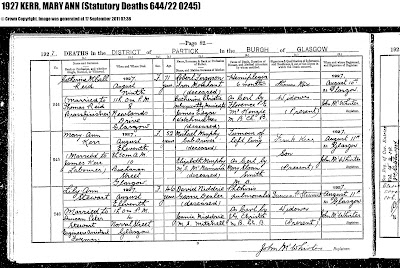
She returned to live in Glasgow with her cousin Anne McConnachie who nursed her through her illness. She died on 11 Aug 1927 of a tumour on the left lung at the McConnachie's house shortly after returning and is buried with Catherine and Francis at St Peter's Cemetery Dalbeth 1246 section 13 N. 

The McConnachies were lifelong friends and relatives of the Kerr boys. Ann McNamara was Mary Ann’s aunt. She married John Blackwood. One of their children Anne (Mary Ann’s cousin) married David McConnachie. Their children became the second cousin’s of the Kerr boys. The surviving children William, Annie and John never married and the Kerrs and the McConnachies were extremely close. William was both groomsman at Frank’s marriage and informant at his death. Mary Ann’s cousin therefore nursed her when she returned from Australia until her death within the year.

Frank continued to live with the McConnachies until his marriage and then after his premature death in 1956 John and Annie cared for Catherine, his wife when she died in 1957
John and Annie McConnachie -also "Irish  cousins"

Back in Australia Mary Ann’s husband and sons, James and Alf worked in a variety of jobs.  James and Lavinia had married early in 1927 and settled at Neutral Bay. Alf and James senior were living with them and a couple of years later their young daughter Jean came along. Sadly Lavinia and James’ first child Jean died of diphtheria in December 1932 but nine months after in September 1933 Alfred (Alfie) Jnr was born followed by William (Billie) in 1935.
James Kerr and his sons- "the little Greek boys" because of their complexion
Alf was initially sorry he came to Australia - they had left good jobs and it was difficult to get work in Australia. Their initial difficulty finding work had taken the shine off immigrating to Australia as did the sadness over the death of their mother back in Glasgow. The Great Depression was beginning to loom.
Craig Grellman summed up the times in his eulogy for Alf in 2001.
“Not long after arriving they found work in the construction of the Sydney Harbour Bridge. So Alf was the bloke who built the Harbour Bridge with his brother, James, helping him. It's a little corny but it’s neat to say that you know a bloke who built the Harbour Bridge.
During the Great depression Alf and James made a living selling fruit from a cart they pushed around the lower North shore. Thrift and hard work soon saw them sporting a horse and cart. Hard work paid off soon they had a V8 utility which Alf boasted was one of the very few motor vehicles on the North shore at the time.”
The horse called Jean was parked at Birches Bakery down the road from their place at the cnr Military Rd and Ben Boyd Rd at Neutral Bay. Billie, James’ son elaborated on the beginnings of the Fruit and vegetable run. To get the business started they originally bought one case of tomatoes for say 2/6d and sold them at a profit. Then bought 5s worth the next day and eventually expanded to fruit and vegetable horse and cart delivery.
Jean the horse- another relative is following up on a gypsy angle
Mary Ann’s husband James Cross Kerr died on 17 Jul 1937. He had lived at 35 Park Ave with his sons and grandchildren until his death at 61. He is buried at Northern Suburbs Catholic Cemetery. (Macquarie Park Cemetery Vaug RC Lwn  row 45 0090)
After his death the boys continued the delivery business buying the V8 Utility in 1939.
Always remembering their Scottish roots the Kerrs celebrated New Years Eve in the Scottish way (singing and dancing) at James and Lavinia’s home at 35 Park Ave, Neutral Bay.   At midnight everyone went outside and stranger with the lump of coal was greeted.  The Scottish Hogmanay tradition is that the arrival of your first guest on New Year’s Day must be a tall, dark male bearing various gifts. It is said to bring good fortune to a house; fair-haired males and females are traditionally considered unlucky. Children were given small gifts. Three children who came to the house for New Year were the children of James workmate Hughie Campbell. They remember Lavinia’s exquisite Shortbread and receiving a one pound note each as they left.
On other occasions they frequented the Scottish Burns Club in Sydney.
In the following years Alf and James got more stable and better paying jobs. Alf was a welder/driller and James worked on the Railways. 
 Alf married Mary (Mollie) Buckley in 1944 moving to Rose Bay where they started a family and remained for the next 18 years. They then moved to Bondi where they lived with Auntie Jessie and children Mary, Mark and Anne. The house at Rose Bay gave him particular pride - there he was, a labourer, with his own home in Rose Bay.  People would not believe him when he told them where he lived.
Alf and Mollies marriage
James began working as a porter and station assistant at Central Station with the NSW Railways where he remained for 22 years. He and Lavinia were proud of their boys who were great athletes and footballers. Lavinia spent a lot of time helping the nuns out at the convent. The family was so highly respected in the St Josephs Neutral Bay catholic community that when Lavinia died of breast cancer in 1960 the nuns organised a guard of honour by the school children at her funeral.
Another shot highlighting the dark "Irish "complexions of the Kerrs 

Frank having returned to Scotland continued to live with the McConnachies- Annie McConnachie and children Annie, William and John.  William was Frank’s groomsman at his wedding to Catherine Toland in 1930.
Frank and his "Irish second Cousin" William  at his marriage
Frank  was working as a Chauffeur at time of his marriage. Because of his love of the theatre he becomes a Cinema/ Theatre manager. There are some interesting photos of him on stage with artists promoting movies.

Frank is centre stage
He met an early death on Christmas Day 1953 dying of a fractured skull subdural haemorrhage as a result of accident at theatre. William McConnachie, his second cousin was his witness at wedding and informant for his death.
Returning to Scotland to revisit the roots
As children we always heard Uncle Alf and James our Grandfather talk of streets in Glasgow and their childhood. The McConnachies and their cousins the McBrides were always mentioned- despite the distance and time away they were always remembered fondly. The Kerr boys never forgot the generosity of the McConnachies- firstly Ann nee Blackwood  McConnachie with their mother, then providing board for Frank until his marriage. Finally Annie and John’s support of Catherine Toland Kerr when she died.  
James, when he retired in 1966 planned a trip to Scotland. He had three ambitions. Firstly he wanted to return to Glasgow.  His second ambition was to see the McConnachies to thank them and give them something in reward for their generosity.  Thirdly he wanted to put flowers on the graves of his mother, Frank and Catherine. They are all buried together under the one tombstone.
 He wrote of his disappointment in Glasgow. He felt a little ashamed of his treasured hometown. While there he spent time with the McConnachies and visited the graves. He also managed to contact his cousins the McBrides who also hailed from the Irish roots of his mother. 
Alf too returned to Scotland for holidays when he retired. He never lost his accent and excitement over his Scottish roots in Glasgow. When the solicitors were trying to trace possible recipients under the will of John McConnachie, Alf was able to provide a run down of addresses and stage names for the remaining McBrides and Australian Kerr relatives believing them to be the closest relatives and most likely beneficiaries.  
Alf’s daughter, Anne lived in Glasgow for a time relishing in seeing the names of streets regularly spoken about. She also visited the grave and took the grave photo . 
My husband and I  visited Glasgow and Ireland in 2014.  After extensive research of the Kerrs and Murphys we are not much further with the Irish roots.  Census records tell us they are no more than 2 generations Scottish but surviving Irish records are hard to come by.
Even Lavinia’s background has been revealed to come from the English. She was only third generation Scottish on her father’s Strelley side. I laughed when one of the Glasgow relatives exclaimed “don’t tell me we are British!” Lavinia’s relatives were royalists dating back to William the Conqueror in 1066.
But you know what – I still feel more Scottish than Irish and English. For three days during my trip to Scotland   I tried to channel the Murphys, McBrides, McNamaras and the McConvilles by visiting and photographing pubs, tenements, addresses and saluting the Celtic Club as we drove by.
 I too visited Mary Ann’s grave- a few more lichen adorn the grave stone and I intend to add the photos to an online grave website for posterity.  Her pictures reproduced in this story are both haunting and treasured.  I think it would be great to explore the Irish heritage further to find the story of her parents and grandparents.
I wonder what James and Alf would make of the news that they were more Irish than Scottish and I’m hoping they will send me a few hints! Perhaps there is an explanation for the olive skin and dark hair and the “black Irish side” of us will become less of a myth.  I’ve some ideas for more research and think it involves a trip to Northern Ireland. Watch this space.
Post Script : 

My DNA ethnicity with a big chunk of Irish   - I also have a small percentage Iberian Peninsula