Search This Blog

Showing posts with label Mark Strelley Fryar. Show all posts

Monday, 10 November 2025

Mark Strelley Fryar - a Case of Barbed Wire Disease?


I've written about my relative Captain Mark Strelley Fryar 1892- 1931 before. In my eyes, he was a war hero and a good leader but others may have seen it differently with a touch of ignorance or dismay probably due in hindsight to lack of understanding of war caused neurosis.

Born in Derbyshire of a mining background he was destined to work in the family mining interests. After completing school and attending Malvern Officer Training College he had prepared to enter the mining business training up under his father, Mark Fryar at Denby and with his uncle at the Messrs Barber, Walker and Company Limited.

Mark from a 5th Bttn photo

In May 1911 he joined the 1/5th Battalion of the Sherwood Foresters (Nottinghamshire and Derbyshire Regiments).  This territorial regiment was mobilised for war service on 5/8/14 when Mark was 23. Less than 4 months after landing at Ypres he was wounded at Dickebuse. He returned to the Front.

Mark's story is recorded in "A Lack of Offensive Spirit" The 46th (North Midland) Division" by Alan MacDonald p392-4. He was captured at Gommecourt in 1916. Initially, he was missing in action after the horrific events of the Somme on the 1st of July 1916-one of the bloodiest battles in history. 

On the night of the battle ....Owing to smoke he and his Captain were separated from the rest of the Battalion. Captain Lewes was hit three times and while Fryar and his men took other action to secure their safety they needed to lay low until cover of darkness or reinforcements appeared. The Germans kept bombing them until 11am and sent an English speaking soldier to say he would take them prisoners. They were out of ammunition and by 12.30 they were being shelled by their own forces. He talked with the injured Lewes and they decided to give in asking the Germans to help them with their wounded. They would not and just looked on. They carried the semi- conscious Captain out but he died the next morning. Then... He was sent to a POW camp or two during the next few years of the war.

Initially his mother, Louisa received word saying “ I'm afraid I can give you very little hope.”


 A month later she received a telegram saying he was a prisoner of war at Gutorsloh, Germany. Mark’s Prisoner of War transfer cards are marked with red circles indicating multiple escape attempts. He moved between Custria  (Fort Zorndorf) and Schwarmstedt camps (30 days in the cells for escaping) then to Schweidnitz where after several months he escaped with 23 others and a partner named Bush. The upshot of this was that he got 78 kilometers away but was caught taking a train.
A Red Cross Transfer  record- the red circle indicates he is prone to escape


The prisoners involved in the Schweidnitz tunnel escape were taken to Holzminden POW camp. A few months later he was court-martialed by the Germans for escaping by the tunnel and for forging passports used in the escape. (He served 47 days in the cells for escaping)

Like many of his fellow captives Mark was eligible for internment in Holland. Having been captured in 1916 he was entitled to be interned after two years captive to a neutral country like Holland. Here they would be bound to conform to laws and regulations for the rest of the war by their personal honour and good behaviour “on parole”.

Authorities were becoming aware of “barbed wire disease”, a new medical phenomenon of war. About 10% of prisoners made a concerted effort to escape, and about three times that attempted breakouts.

Military staff POWs felt a deep disillusionment, enhanced by the solitary confinement for punishment, overcrowding and harsh living conditions. They were going stir crazy. It was considered that men captured for more than two years would be suffering from barbed wire disease and should be offered internment in a neutral country. Many of his fellow prisoners refused this eligibility because one, it meant they had to sit out the war and two, they did not get to escape to fight another day. Many wanted to return to their unit to fight or fly again.

Even though the officers were able to enjoy orchestras, workshops, sports, and theatre, the physical response to being behind barbed wire for prolonged stretches of time would send the prisoners stir-crazy. Solitary confinement that was issued after the prison break would further deepen their disillusionment. The Hague Convention states that prisoners must be treated humanely. Officers were not put to work. They were to be treated with the same board, lodging, and clothing as the troops who captured them.

German officers often violated these conventions. The Commandant at Holzminden, Niemeyer, for example, was well known for the way prisoners were harshly treated. The men survived because of Red Cross parcels even though 1 in 5 were lost in transit! Letters home show that Mark asked for his mother to send him a parcel from Fortnum and Mason. I wonder if it ever arrived.

He became a Captain during his incarceration and would take his role seriously writing reports when necessary .


Mark believed that the delay in going to Holland was caused by the Germans dragging out the court-martial for their part in the Schweidnitz escape. This delayed his and others' transition to Holland and he believed it was in breach of the Hague Convention Agreement. And he let the management know via a letter to the Dutch Ambassador requesting that the British Government investigate the delay. Family believed he was depressed by this delay as letters back home revealed during 1918. We now know this was probably part of the psychological distress that Prisoners of War  suffered. It is also known that internees  suffered the same effect.


Part of the military code was that you were expected to escape whether English, NZ, Aussie or Canadian. Since the other big escape from Holzminden the Germans were more harsh. Another of Fryar’s report from the Officer’s Camp at Holzminden was about the random shooting of two Aussies, Lt Alexander Wallace Couston 10th Battalion AIF and 2nd Lt Cyril Boyd Fenton RFC in Oct 1918. https://schweidnitzpowcampwwi.blogspot.com/2021/04/another-escape-remembered-anzac-day-2021.html As I said before, I liked his leadership. It seemed he created quite a stir. He’s not writing his report to condemn the men but as a condemnation of the behaviour of the Germans during the men’s escape.


He was eventually interned in late October 1918. Mark went to Holland with fellow escapees Asquith, Burrow, Bush, Moorhead, Patton and Murphy.  Most were repatriated on the 26th of November 1918 after the Armistice was reached.

Officer's statements were obtained upon repatriation. These explain the circumstances of their capture and recapture. Many of Mark's, part of Mark's capture statement describes his capture while serving with the 5th Sherwood Foresters.

His experience of war made it difficult to return to normal life and his father's colliery business. In 1915 his uncle had died and this put more pressure on Mark to assist in the business. All the blasting and confined spaces involved triggered what we now know to be PTSD. Local rumors were around and perhaps some  misunderstood as to why and how  he was captured, escaped, recaptured and treated after the tunnel escape.

Perhaps a little misunderstanding as to why he was court-martialled by the Germans and not the English, may have persisted in his local village and family. In April 1919 he had received word that his statements regarding his capture by the enemy had been investigated and it was considered no blame at all on him in the matter.


 After the war he could not settle and returning to the colliery meant claustrophobia. Anxiety caused by the constant blasting in the mine unsettled him. He was given time to recover by his father but in the British way after 12 months he was expected to pull himself together and get back to work. This caused friction with his family assisted by persistent rumors about his capture and court martial.

Post-war mental illness was probably exacerbated by his lack of work and idleness. Rumours persisted and he was known to drink too much. Some incidences occurred unbecoming of the gentleman he was.

In 1924, he was acquitted of breaking into a garage at Stubbington and stealing five motor tyres and two tins of petrol. He denied he was the person seen leaving the garage at midnight, and that the evidence was circumstantial.

Acquittal- Gloucester Citizen 8/10/1924

 In 1926 he was charged with being in the Wesleyan Church after dark for unlawful purposes having forced the door. The judge satisfied that it was a drunken episode and in exchange for damages and expenses Mark was accordingly discharged.

More trouble - Mansfield Reporter 18/6/1926

At age 39 in 1931, he died- a bachelor. He had been living between Long Bennington and Denby and after a visit to the pub was involved in a car accident while on a cycle. He died of head and internal injuries   

He was buried with military honours.

Notes from a talk given by Jill Sparrow to a local group

Such a shame that, in hindsight Mark was probably suffering undiagnosed trauma. We now understand more about these war neuroses, probably initially caused by shell shock from his part in the Somme battle and exacerbated by barbed wire disease. Studies show that mortality rates of POWs in the 1920s and 30s were five times that of other veterans. An added cost of war.

Remembrance Day 2025

Lest we Forget


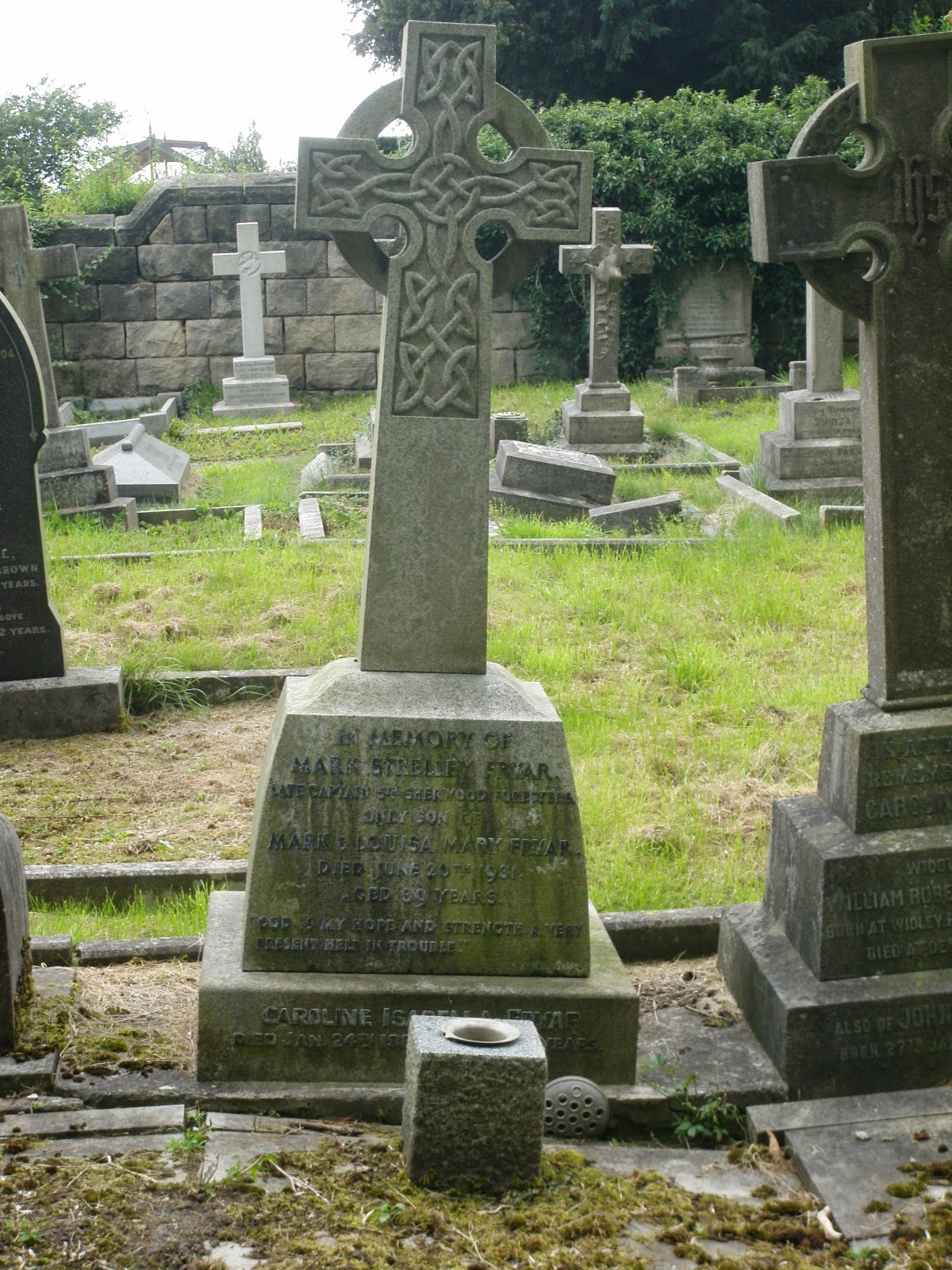
Mark's grave in Denby with his sister Molly


Sunday, 13 September 2020

More About the Escape from Schweidnitz POW Camp


Schweidnitz POW Camp 1918


Since I wrote of the six Aussie and New Zealand POWs in my Anzac Day tribute Blog link I’ve been introduced to the rest of our “international“ research team- all relatives of the tunnel escapees at  Schweidnitz POW camp. Several others want to be kept in the loop and are eagerly supplying their own bits of memorabilia.

 Ruve from New Zealand, is the granddaughter of George Tarn Harker, John and Gail from Canada are the grandchildren of Arthur Harold Madill Copeland and James from England, is the nephew of Aubrey Robert Maxwell Rickards. My relative of course is Mark Strelley Fryar a third cousin. We have been helped along by an historian, Roger who has previously looked into the story and done some pretty decent research.

A rapidly growing collection of records, memoirs and stories are making our POWs come alive and we’ve started to see how their previous experiences make them candidates for escape. For example, Mark was a serial escapee.

The POW camp held Australian, New Zealand, Canadian and British officers some from infantry and many who had been shot down. The life in the camp is dreary and they long for food parcels. Days are long. They are frustrated that others are fighting in the war without them and that they have let others down. These men are officers of the British forces. They are smart and often have a mechanical or hands-on backgrounds.  It’s a long time between letters and Red Cross parcels. Boredom and being housed with others who are multiple escapees lets their minds tick along with ideas of escape….

 In addition, building on experiences of fellow POWs, they acquire skills in making saws and rubber stamps, forging papers, clothing alteration and generally how to outsmart the Germans with elaborate escape plans. Precision planning was required.

 The story continues with our team member’s stories of 4 more POWs….

Lieutenant George Tarn Harker 1894- 1983 (Contributed to by Ruve Baker)

When George Tarn Harker was born in April 1894 in Nutfield, Surrey, England, his father, Henry, was 33 and his mother, Marianne, was 22. Tarn had an older sister Mabel born Sept 1892. They had a younger brother, John Gordon Harker born in January 1898. John served in WW1 and died on September 28, 1918, in France at the age of 20, and was buried in Pas-de-Calais, France.

George Tarn Harker 1915

Tarn originally began his war service in the Honorary Artillery Company. His first overseas posting was to France in 1914. During leave he applied to the Royal Flying Corps as pilots were desperately needed and after six weeks training in England Second Lt Harker returned to the front in April 1917. By 23 June 1917, while returning from attacking balloons he was shot down over Belgium 10 miles behind enemy lines. His engine was shot in the benzene tank which forced a landing behind the first and second line of German trenches near Dovai. Tarn’s short memoir of his time as a POW was recorded by his wife before his death in 1983.

So important to record memories before it's too late

He was taken to Schweidnitz POW camp.  Being an officer, he was afforded freedom to do at will provided he attended roll call in the morning and afternoon.  He was one of the instigators of digging the tunnel using a spoon and a shuttle of mugs to carry the dirt. 

 On 19th March 1918 Tarn made his escape with Atkins and 22 others. He had escaped through the tunnel. Lt. Atkins was entombed by the tunnel collapse after the first 23 went through. He was saved by the gallant effort of an Air Force POW Lt. Harker, who was small enough to crawl through the collapsed tunnel and bring Lt. Atkins to safety. They travelled in pairs with the intention of escaping through Austria to Switzerland, travelling part of the journey on foot and part by goods train.

 This is from a report by Mark Strelley Fryar “They took the following route :- SCHWEIDNITZ to CHARLOTTEN BRUN, over very hilly ground across the frontier.” “They travelled via :- JOHANNESBURG, JOSEPH STADT, BRANEAU, NACHOD,KONIGRATZ. “ "Lieutenant Harker was caught here and taken to a men’s camp at PARDUBITZ, where Lieutenant Athius(Sic)  joined him. They declared themselves to be officers, but the authorities would not believe them, as they were in civilian clothes, and told them they would have to remain where they were until they received confirmation from Schweidnitz, which would probably take about three weeks.”

 “Whilst at this camp they were told by Frenchmen in the camp that the French working on commandos & c. in southern Germany were going across the frontier in twos and threes because of the better treatment they received. There was plenty of food in the camp and the ‘Checks’ in the district were friendly towards the Allies. The camp was fairly easy to escape from so they decided to try and go back to Germany when they heard they were going to be detained. They escaped and recrossed the frontier and had to give themselves up at GORLITZ owing to running short of food.”

 They planned to travel in pairs and after being captured once, escaped again to return from Austria to Germany. They gave themselves up. So, after three weeks on the run they were taken prisoner again. Like the others Tarn was sent into Holzminden POW until Armistice and their repatriation to England.

Tarn and his family lived at Mercers Farm in Nutfield, Surrey, UK and were farmers. Tarn, together with his parents, Henry and Marianne, departed England on 13 August 1926 and immigrated to New Zealand. They settled on a dairy and beef farm in the Otorohanga County. Tarn's fiancĂ©, Enid Gabrielle (nee Wood) arrived in New Zealand in 1927 and married Tarn a couple of days later. Enid was 24 years old. Tarn and Enid had four children during their marriage. Tarn's mother, Marianne died in 1931 aged 58yrs. His father, Henry died 28 years later in 1959 at the age of 98yrs. 

 Tarn developed his dairy and beef farm and when he was 40 years old, sold the farm to his two sons - Peter and Graham, who continued farming in partnership. Tarn enjoyed tending to their large garden and grew amazing vegetables in his garden plot. Tarn's passion was fishing mainly in the Kawhia Harbour. Tarn died on January 14, 1983, in Te Awamutu, New Zealand at the age of 88 years.

George Tarn Harker in RFC uniform

 Lieutenant Arthur Harold Madill Copeland 1889-1984 (Written by John and Gail Copeland)
Arthur Harold Madill Copeland was born in Winnipeg, Canada on August 27, 1889. He was the middle of three children; his sister the eldest and a younger brother. He was twenty-six when he enlisted in the Canadian Army in 1915. At first, he was rejected because he didn’t weigh enough, however, he knew a major who was able to get him a commission and he accepted. He trained, drilled and passed his exams with flying colours. He started out with the Canadian Army Service Corp and then took a mechanical transport course.
Arthur Harold Madill Copeland

 On December 31, 1915, he sailed from Canada to England. The British were short of truck drivers and Arthur was selected to be a driver. He picked up new recruits and delivered them to Whitley Camp in the beautiful Surrey, England countryside. It was there where many new recruits received their initial military training. When his training was completed, he was sent to France with the Motor Transport unit and while there, in March 1916, he contracted red measles and had to spend some time in the hospital. In April 1916 he switched to the Third Ammunition Corp. where he drove supplies and ammunition close to the front lines. Men on foot carried them into battle. In mid- summer of 1916, after talking to members of the air force, he decided he’d like to join the air force as well. He went for an interview while in France and lied about having machine gun training. On Aug. 26, 1916, he joined the R.F.C. - 25th Squadron as an observer. This squadron was a Reconnaissance and Bombing unit. It soon became apparent that he lacked the machine gun experience so he was sent for a one-week training course. Pilots were given estimates of six to eight weeks to live while on active duty. The pilot that Arthur Copeland was teamed up with had had a total of six flying hours under his belt.

 On October 10, 1916, as part of the 25th Squadron was returning from a bombing raid, they saw what appeared to be a German observation balloon. Since no German planes were sighted, one plane decided to get rid of the sausage.

 Here is what happened in Copeland’s own words "...we were ordered to bomb Oppy. Two flights, or sections, detailed for this raid. Both Hayne (Moreton Hayne, his pilot) and I were scheduled to go in first section...dropped bombs on the marshalling yard and turned back for home when the leader of the section, Capt. C. H. Dixon, saw a German balloon and went to strafe it; both FE's (25 Squadron flew FE2b aircraft) followed him. Richtofen's (Fighter Ace, Manfred, also known as The Red Baron) squadron were up top in the sun. Three of them came down on us. I was sitting on the usual petrol can working the front Lewis which immediately jammed, so I stood on the can end, got up to work the second Lewis. I fired several bursts at an EA (enemy aircraft) which had made a pass and got several bursts at him; then, this gun also jammed. While I was trying to clear second jam, a plane dived from behind and above and fired a burst which killed Hayne and hit me in the left knee and left arm. The dead pilot immediately fell forward on the stick and the FE started to dive fairly steeply in wide controlled circles. I couldn't get into the back seat as the pilot was slumped forward on the controls, but managed to push the limp body back and pull the 'joystick' back. Realizing the aircraft could land in the town of Vitry, I pushed the stick forward to reach the ground before this occurred...pulled back stick, levelled off to complete stall, pulled up nose, dropped 20 feet and did a pancake landing! I couldn't move and waited until the pilot of the German machine landed and shook hands. He said, "you hit me with one burst!"

 Through the reading of many historical documents, it is believed that Baron Von Richthofen fired the first shots but had to veer off to avoid a plane on his tail. The credit for the downed plane was given to Fritz Gustav Kosmahl.

 Arthur was taken to a hospital in Vitry. It was two months before he was located and reported to be a POW. He spent time in several different camps and by late fall of 1917, he was imprisoned at Schweidnitz. This is where he made his first escape. Initially he was part of a group of eight who decided to dig a tunnel starting from a hole in the barracks floor and ending up outside the fence. In the end, twenty-four men left through that tunnel on the night of March 19, 1918. Arthur was recaptured and spent two weeks in solitary confinement. On April 16, he and the other re-captured escapees were sent by train to the Holzminden POW camp. Arthur and one of his buddies decided to try another escape and asked the guard if they could open a window to let some fresh air into the train car. Later, when the guard fell asleep, the two of them jumped out the window to freedom. They managed to avoid capture for two weeks until they reached a bridge across a river. They were four or five miles from the Dutch border. They watched many people cross the bridge without being stopped so they set across. There was a sentry on the other side who had been hidden and they were stopped, detained and ended up in Holtzminden anyway. They were court martialled and spent the rest of the war there.

Part of a letter back to Hilda- he talks of "barbedwireitis"

During Copeland’s time as a POW, he regularly wrote and received correspondence from his future wife, Hilda Reeve Lailey. They married April 28, 1920 in Toronto, Ontario, Canada. It is unknown whether they were just friends before he went to war or more than that. From the tone of their letters it appears that they were not romantically involved until after the war. In Dec 1918, after the camp closed, he wrote home and said he was “full of emotion and thoughts of the future.”

 Arthur had three sons and his eldest fought in World War II with the Canadian Army. His middle son followed in his footsteps and trained with the RAF to be a pilot. He received his wings just as the war was coming to a close and they no longer needed pilots overseas.

In 1921, after the war, Arthur worked for Laidlaw Lumber Company in Toronto, as their accountant. He rose to General Manager and V.P. and retired at age 70. At that time, he went to work as an accountant for his youngest son who had started his own retail business called Copeland Lumber. He worked there until he was 90. He commuted by train every day and during a local transit strike, in his early 80’s, he hitch-hiked from his house to the train depot, for several weeks.

Arthur is on the left

During the Second World War, there was a critical need for planes–and for trained young men to fly them. The Air Cadet League was established in 1941, to train young men for overseas service. Arthur was involved with training the Air Cadets in Toronto with the Mosquito Squadron.

According to his son, Don Copeland, Arthur was quiet, patient, laid back, tolerant and optimistic. He loved nature and fly fishing. Every year he would go into the remote, densely wooded areas north of Toronto to fish. He would often fly in by small float plane, sometimes taking his sons with him. The war for him was left far behind.

 He died in Toronto, Ontario, Canada on October 18, 1984, at the age of ninety-five.

 Wing Commander Aubrey Robert Maxwell Rickards 1898-1937 (from extracts from the archives and memoir of Rickards supplied by James Offer)

When World War I broke out Rickards was an agriculture student at the Royal Agricultural College, Cirencester. He enlisted in 1915 when he was 17 and trained as a pilot in the Royal Flying Corps before being sent to France March 1917 for his two-week career as a pilot!

Rickards was the much older brother of team member James’s mother Stella. After landing in France in March 1917 the Second Lieutenant an “exceptionally courageous young pilot” was wounded in action. When he’s captured Major MJ Christie of the 100 Squadron RFC writes in a letter to his mother “I feel sure our enemy will treat him well and with the respect he richly deserves.”

After he was shot down, he became a German POW for the rest of the war until his release in 1918.

He described the prison….

“The Prison Schweidnitz is about 25 Km SW of Breslau on the river Weistritz. The prison itself was situated on the site of an old fortress on the west side of the town, the fort being on high ground with a moat running partly around it. The fort had been converted into a workhouse before the war, and in 1917 it was made into a prison for British Officers. Upon the North and East was the town, and on the South, and West was the moat and a river. Round the prison itself was a high wall which was covered with barbed wire, on the inner side of the wall was a neutral zone, which we called “no man’s land”. Round this zone sentries were posted, in addition to sentries in the crows’ nests, which were built upon the wall, there were four wooden huts, one stone building and a wooden Church. Officers lived in huts except W1, which was Hun headquarters. In the stone building was a dining room and living quarters for 120 officers, and not to be forgotten the cells and guard room. The Church was only used for one service on Sundays by the kind permission of the Hun. Besides these buildings there were the kitchens, bath house, rubbish house, and gate hut, but there was a little space in which to take exercise, and in this space fruit trees were growing. (I did not see any fruit).”

A sketch of the escape route and the infamous pigpen

He was one of the 24 escapees who planned the tunnel escape from Schweidnitz after attempts at two other tunnels. He escaped 10th and partnered with Captain Frank (Neville) Hudson MC. Rickards tells us that there were 48 helpers seeking to escape. The working parties went first. The 25th man got stuck and in the efforts in pulling him back they caused the very small tunnel to fall in.

As with the other escapees he was recaptured but not before, four of them out of the 24 managed to escape from the train while on their way to Holzminden, Lt. Copeland, Lt. Holley, Lt. French and Lt. Rickards, were the four who escaped from the train. All were eventually transferred to Holzminden for a stint in solitary confinement and to wait until Armistice and Repatriation to England.

Rickard’s legacy from his POW days is the survival of the sketchbook/autograph book capturing snippets of captive life.  It’s titled Skizzen which is a German word meaning sketches. His book is full of about 80 drawings, autographs, addresses and photos including those contributed by fellow prisoners. Eight of the prisoners who escaped with him are immortalised and there is an incredibly detailed sketch of the mens’ tunnel and escape plan. After all the effort to get into the clear they came out in the middle of a pig pen! Not content with chasing up the POWs who escaped with Rickards, James is trying to find the whole 80 contributors to the Skizzen sketchbook.  In addition, Rickards left a detailed memoir of the escape attempts, preparations and recapture.

Another sketch and autographs from the Skizzen  book

After the war he got into a permanent RAF commission. He married Anna Buhler in 1929 and had two children.  Rising from Flying Officer to Flight Lieutenant, Squadron Leader and Wing Commander he had a distinguished military reputation particularly in the Middle East. He’s described as having “modest charm and unpretentious matter”.

He was awarded the Air Force Cross in recognition of his work in locating two missing men in Transjordan and was made an Officer of the Military Division of the Order of the British Empire (OBE) in recognition of his work as an Intelligence Officer in the Aden Protectorate. His other post-war work entailed flying instruction, surveying and mapping, intelligence work and was Official advisor to the Sultan of Makalia.

Wing Commander Aubrey Robert Maxwell Rickards known affectionately as “the Flying Lawrence” was one of a party of three killed when their plane overturned when landing in Khor Gharim on 30 October 1937. He had been working as a liaison officer in the Middle East and had a wealth of experience there.  So ended the life of this interesting man. He was re-buried at the Christian Cemetery, Muscat, in May 1998.

Captain Mark Strelley Fryar 1892-1931

I wrote about Mark in a previous blog before I found out about the Schweidnitz escape so I’ll include a little bit more that I’ve found since. Mark's Blog    

Mark Strelley Fryar

Mark the only son of Mark Fryar and Louisa Strelley was a career soldier. He trained in the OTC at Malvern College.  Part of the recently renamed Sherwood Foresters, Mark became Missing in action after the horrific events on the Somme on 1 July 1916. Mark’s mother received a telegram on August 1 saying that Fryar was a POW at Gulersloh Germany.

In a statement made at the end of the war Mark described his capture and then concluded with his POW and escape history. During his incarceration he was promoted to Captain.

“I attempted to escape from Schwarmstedt in May 1917 but got caught outside the camp and did 30 days cells and was sent to Fort Zorndorf, Custrin for 7 months.

On March 19th 1918 I escape from Schweidnitz, Silicien and got 78 kilos and was caught taking the train. I was court-martialled for mutiny for going through a tunnel this was not done till(?) Sept 27th 1918 and given 6 months after the war. I was held back awaiting this ___ 4 months from exchange to Holland. For the same escape they court-martialled me for forgery for making passports in order to help me escaping. ___ close proceedings of this __. I was fined 150 Marks. I had already done 47 days cells for the escape.” Bush had escaped with Fryar from Schweidnitz.

His war experiences did not help him when he tried to return to his father‘s business at the coal mine with all its blasting and confined spaces. A letter in April 1919 informs him that his statement regarding the circumstances of his capture by the enemy and been investigated and it was considered no blame at all on him in the matter.

 With the rumours around his capture and German court-martial persisting after the war he was known to drank a little too much. I guess this would today be treated as PTSD. In 1931 Mark had visited some friends at the pub and collided with the car on his push bike on his way home. He was killed instantly by a slither of glass which severed his artery. He survived the Great War only to succumb in such an accident. He was buried with Military Honours at Denby.

Officers of the Sherwood Foresters
The search continues…..  Information arrives in the inbox daily, a chance Google yields results, photos are unearthed which lead to further investigation. Stories of all the others are in the pipeline. If you know someone who was in Schweidnitz POW camp in WWI or indeed one of the 24 escapees please Contact our group.

A blog dedicated to the Schweidnitz research right through to repatriation now exists at 

https://schweidnitzpowcampwwi.blogspot.com/


Saturday, 25 April 2020

ANZAC DAY 2020 -remembering the Schweidnitz POW escape 19th March 1918


It’s ANZAC Day 2020 and we are in “iso” with the Covid 19 scare.  This is an important day for every Australian and NZ citizen remembering not only the slaughter at Gallipoli 1915 but all our diggers.  

We can’t celebrate their sacrifice in all the usual ways (Dawn Service, ANZAC street marches, picnics, drinking and two up at the pub ) It’s made all the more poignant when the Covid virus is affecting the very same people who fought in the wars and because of time going by they are diminishing in numbers.

We don’t forget these service men and women and despite the isolation we must continue the Anzac tradition. So, I’m writing about 6 of these remarkable men.


This year I’ve begun researching a group of 24 Australian, NZ, Canadian and English who fought, were captured, rounded up into POW camps, escaped …..perhaps more than once.  This is real Hogan’s Heroes stuff.

I’ve heard some of the main techniques used to escape by our allied servicemen were tunnelling, dressing as a German guard, a woman or citizen. Well this lot used a spoon!

The Schweidnitz POW escape occurred on 19th March 1918. Twenty-four officers were involved in the escape via a tunnel. 22 were recaptured and were returned to camp after three weeks and were tried by court martial. The Court martial papers make interesting reading. According to a letter from one of the UK escapees, Tarn Harker, “the tunnel was made by excavating with metal spoons, putting soil into mugs – tied with string which was shuttled back and forth. Only one man could work on the tunnel at one time”. They were free for just over three weeks and were heading for Switzerland but succeeded in getting over the border into Austria, before they were recaptured. The escapees split up, used trains and disguises and stole food to survive.

 Escapees 19/3/1918- Recaptured list

I’m still gathering up information on these brave chaps. Amazingly, some served and returned for the next war.

My interest is that relative Mark Strelley Fryer was one of the escapees. He’s from Derbyshire England. I’ve written about him here.


This blog is to honour what I know of the Aussie and NZ escapees so far.  

Many of the Aussie fighters left Australia as part of the Australian Infantry Force. Upon reaching England they were discharged from the AIF and became part of the Royal Flying Corps, were shot down or captured.

Here’s a little bit about Mark’s Aussie and NZ cohorts.

One of the Schweidnitz escapees with Mark Fryar was Gus Avey of NZ.

George Augustus Avey  1892-1976 was a Lt and Captain in the NZ Rifle Brigade 2nd Battalion. He was awarded a Military Cross on 13/12/16 for conspicuous gallantry in action. His war records show him going missing and believed to be in a POW camp from 28/6/1917 at Karlsrule. After escaping from Schweidnitz he was transferred to Holzminden. He did assist with the great Holzminden tunnel, but at the time of escape Gus was held in 'confinement'.  In the London Gazette he was commended for gallant conduct in attempting to escape from captivity.

George remained in the Army as a reservist after the war and served again in WWII. On 21st August 1931, George Augustus Avey became the Publican of the Waipa Hotel, Ngaruawahia, New Zealand. His father (George Augustus Avey 1869-1939), transferring the License over to him.

He died in Auckland on 29/9/1976.

NZ er George Augustus"Gus "Avey

Eric Paul Fulton 1891-1982 was a Mechanical engineer from Victoria Australia. After landing in England with the Australian Infantry Force 14th Battn he was discharged and joined the English Royal Flying Corps.

At Pozieres Lance-Corporal Fulton was wounded in the shoulder, thigh, and right hand, but the Australian casualties were so numerous that he had his wounds temporarily dressed by his comrades and volunteered as a stretcher-bearer. Three weeks later he was being congratulated by Major-General Sir H. V. Cox, commanding an Australian division, for his gallant conduct near Mouquet Farm on August 27 and 28 1916. He rose to the rank of the 2nd Lt. He too was part of the Schweidnitz POW escape.
Eric Paul Fulton -Gallantry in the Field


Alan Barrington “Brolga” Hill  1892-1974 was from Warran NSW.  He also went from the AIF to the Royal Flying Corps 29 Squadron. Around Aug 1917 his parents received a cable stating that their son, Lieut. Alan B. Hill, of the Royal Flying Corp., had been reported missing.  

The Sydney Morning Herald on Sat 30 Apr 1921 reported Lieutenant Alan Barrington Hill, of Killowen, Warren, formerly of the Royal Air Force, was mentioned in the London "Gazette" of December 16, 1919, for "gallant and distinguished services" during the war. Hill also served in WWII


Some good news for the family from Hill's  Red Cross file

Alan  Barrington Hill Missing in Action


Ronald Starr Phelan 1893-1953   After obtaining a Bachelor of Engineering he was originally with the 35th Battn of the AIF from 2nd September 1915.

He reached the rank of Lieutenant. Enlisting 2nd September, 1915, and sailing 1st May, 1916 with 35th Battn., was commissioned in England on  28th August. He too moved to the RFC  22Sqn becoming a  Flying Officer 16th April, 1917.


The Book of Remembrance, University of Sydney says that "Phelan in a Bristol F.2b figher (serial no A7201) was shot down on 17 August 1917 at Passchendaele by Lt Hans Georg van der Osten of Jasta 11 (it was the unit's 200th claim). His observer Lt. J. L. Macfarlane was killed, Phelan was wounded and taken prisoner. "

After the war he was repatriated at Hull 14th December, 1918, and returned for demobilisation. He was promoted to Lieutenant R.A.F., 1st April, 1918. 
Phelan met Emily Frances Howard in England, while he was a member of the Royal Flying Corps. On May 30 1919 they married in London and he brought her to live in Australia. After a stint working away overseas as an engineer he had to file for divorce.

He served in served both WW I and II.

Roland's record of War Service for University

Lionel Read (AKA Alfred John Lionel Lee) 1893-1937
Lionel was enlisted under the name of Lionel Read (possibly his journalist name to distinguish from his father’s). He was a journalist in his father’s paper in Wellington and was later from Sydney NSW. Lionel Lee enlisted when he was 16 and served with a trench mortar unit. He wanted to fly and he succeeded in transferring to the Royal Flying Corps.

He was a personal friend of the late Sir Charles Kingsford Smith having trained with him in Oxford, England during the war for service in the Royal Air Force.

Apparently, he was a distinguished airman. He had several crashes during action, and on one occasion he landed a plane the wings of which had been almost completely shot off by enemy aircraft. German airmen rushed to him, and congratulated him on his airmanship. He was a prisoner of war presumably after being shot down on this occasion.

He was captured at Moorstad and reported missing on 12/8/1917.

His obituaries show him as an energetic and enthusiastic citizen and an avid flyer. He recommended 'Smithy' for a Job with the Diggers' Aviation Company of which Lee was then chief pilot. Later Lee and Kingsford Smith went 'barnstorming' in old Avro planes secured from England, and at several New South Wales country towns many residents made their first flights with these two pilots.

His sudden death at age 43 was attributed to the aftermath of war injuries.

Arthur Wearne 1894-1945
Service no 3381 I believe he was initially an Australian Field Ambulance unit and later Australian Flying Corps 68 Sqn.  Arthur enlisted as a mechanic from Allendale in Victoria. Shortly after being promoted to 2nd Lt on 1/7/1917 he was pronounced missing on 26/7/1917. Having been captured at Ypres, papers showed initially that he was a POW at Karlsrule.

Here's a little Christmas message from his Red Cross file.

Lt Wearne was repatriated to Australia from England on 28/2/1919.

German documentation re Wearne's capture

Lest we forget


We Will Remember Them


Author note: A few of us from different countries are joining together to preserve what we can of the story of these escapees and the events of the escape.  If you are related to any of the Schweidnitz POW escapees please contact me. We’d love to hear from you.

A blog dedicated to the Schweidnitz research right through to repatriation now exists at 

https://schweidnitzpowcampwwi.blogspot.com/


#AnzacDay2020
#SchweidnitzPOWescapees 

Monday, 27 April 2015

Mark Strelley Fryar 1/5/1892-20/6/1931 and Caroline Isabella (Molly ) Fryar 9/1/1896-9/1/1985 Prisoner of War and VAD Nurse


For each story in this WWI series I have tried to have a different focus or story type. This is of a  sister Caroline Isabella Fryar who was a nurse with the Voluntary Aid Detachment and her brother  Mark Strelley Fryar who became a WW1 prisoner of war in Germany.

Mark Strelley Fryar had trained in OTC at Malvern College. In May 1911 he joined the 1/5th Battalion of the Sherwood Foresters (Nottinghamshire and Derbyshire Regiments).  This territorial regiment was mobilised for war service on 5/8/14 when Mark was 23. The Division concentrated in the Luton area, with the 5th Sherwoods at Harpenden. By mid August after preparing for overseas service in Braintree they proceeded to France. They landed at Boulogne on 25th February and joined the British Expeditionary Force at Ypres. On the 12th of May the Division was retitled 46th (North Midland) Division. 

Mark Strelley Fryar
Less than 4 months after landing at Ypres he was wounded at Dickebuse.


In early August his parents, Mark and Louise, received a telegram to say that he was in a POW camp in Gutersloh, Germany. At first he had been reported missing on 1st July in the Newspaper  and then as a prisoner. Major Checkland when writing to his parents re the event stated "He went forward with the Lewis guns and was seen near a German parapet giving instructions to his men. It is believed at this time he was wounded".

Mark's story is recorded in "A Lack of Offensive Spirit? The 46th (North Midland) Division" by Alan MacDonald p392-4

Owing to smoke he and his Captain were separated from the rest of the Battalion. Captain Lewes was hit three times and while Fryar and his men took other action to secure their safety they needed to lay low until cover of darkness or reinforcements appeared. The Germans kept bombing them until 11am and sent an English speaking soldier to say he would take them prisoners. They were out of ammunition and by 12.30 they were being shelled by their own forces. He talked with the injured Lewes and they decided to give in asking the Germans to help them with their wounded. They would not and just looked on. They carried the semi- conscious Captain out but he died the next morning. Mark gave his account in an interview after his return from POW camp on 10th December 1918.


 " It is believed at this time he was wounded"
After attempting to escape in May he was recaptured and received 30 days solitary confinement for his efforts. From there he was sent to Fort Zorndorf in Austria for 7 months.

He was promoted to Captain on 17th June 1917.

On 19th March 1918 he escaped again while at the Schweidnitz Camp but was caught getting on a train. Eventually he was interned and repatriated through Holland in early October 1918 returning home to England on 2nd November 1918 and finally repatriated on 22th Nov1918. There is a comment in the footnotes of MacDonald's book that he was court-martialled for mutiny and for forging passports but I cannot find more at present on this. As his grave refers to him as the late Captain of the Sherwood Foresters possibly all was forgiven.


His sister Caroline Isabella Fryar (Molly) was with the Voluntary Aid Detachment. The role of the Voluntary Aid Detachment nurses and assistants were to provide nursing and medical assistance during a time of war.  VADs worked in a variety of roles which included nursing assistants, ambulance drivers, chefs, and administration .

Whilst most VADs worked within Britain, some were posted overseas such as those with the British Expeditionary Force (BEF) in France during the Great War.  During wartime the VAD organisation was administered by the Joint War Committee of the British Red Cross Society and the Order of St. John.  The numbers of women serving as VADs were around 70 -100,000.

While Molly’s wartime records are unavailable, her medal roll references her as a part of the Territorial Force Nursing Service (TFNS) in the 1(a) theatre of War . This is indicative of serving in the Western Front- France and Flanders.  

She was most likely a War nurse and a relative referred to her as driving ambulances during the war. So it could be assumed she was in France performing some sort of medical role. Her dates were recorded as serving from 20/7/1917 to 22/10/1919.


Caroline Isabella (Molly)  Fryar

Molly returned to England nearly one year after her brother.  Since I heard about Molly through family connections I thought she sounded like a “gutsy” sort. More recently I heard she was a spy in the Second World War. Apparently she was parachuted into France to spy behind enemy lines being  part of the Special Operations Executive which was based in secret headquarters at Bletchley Park, Buckinghamshire. (Source Greg Strelley)

Now I’d like to hear more about that!! Please contact me if you know more - kanahookarob@yahoo.com.au

The Strelley and Fryar families would be proud of Mark and Molly. Neither married or had children so recording their stories feels right.  Mark was killed aged 40 in a cycle accident 20th June 1931. Molly lived to a ripe old age dying on her birthday in 1985 at age 89.

Whilst visiting Derby last year my husband and I visited Mark and Molly's graves which are situated amongst the family plots for the Fryars and the Strelleys.
Mark and Molly's Grave in Derby