Search This Blog

Tuesday, 22 August 2017

Hers, mine and ours- more than a bakers dozen..... the story of Edward James George and Lily Belton


Edward James George (1876-19??) featured as my DNA match this week. He’s my great grandmother’s brother from Yarmouth, Norfolk. He married Lily Belton (1882-1964) in 1919 in Sunderland, Durham.  Can't help thinking the DNA angels are stirring up things in Sunderland. Their granddaughter Sophie is my third cousin.

It's my second unrelated match in that neck of the woods in weeks and my third in this line in as many months. It's a good news story alone that the “Match” with Sophie and I could be found so quickly even though she had only done her tree a week ago.
When reviewing the records of my great great uncle I looked for a possible military record. A pension record gave his children's names and dates of birth (more information than found on the 1911 census). It named his wife- Florence Turner and marriage date. Then a few pages over I wondered why the children had a guardian. A page or two on and duplicate records have been altered -the wife Francis Turner was deleted as wife and another one Lily Belton had taken her place. The details made me look twice. A wartime widow Lily Belton had married Edward.

Edward's children with Frances Turner: Ruth, Maud, Edith, Edward John and Daniel William listed on his military pension record

A new wife  Lily  previously Irwing -widow was his next of kin


I mentioned his record to my new third cousin and she shared an archive with me. It was a link to a one hour video she had recorded of her grandmother Lily George jnr several years ago. How wonderful to hear her detail the “hers, mine and ours” children of Lily and Edward. Besides the family history she also described her house and her whole life time! In all Lily and Edward George were parents to 14 children. I filled in the gaps with Ancestry searches and FreeBMD searches.


Lily and George's daughter Lily recounted their story.


“ My mother had a lot of bad luck”.


Lily had taken on George’s 5 children who are in care in Sunderland. Lily had been married not once but twice before and brought 5 of her own children to the marriage. Four boys with husband George W Armbruster 1877-1911 and one son with second husband George Irwing ( - 1916).

Lily Armbruster as Lily Ambrose with sons George, John Henry, Edwin and Edgar in 1911 census


Twice tragedy has struck her first husband before the beginning of the war. Due to anti German sentiment they changed their surname to Ambrose due to George Armbruster’s German background. Then George died in early 1911 after being crushed to death in a shipyard accident at the age of 34. She’s shown a few weeks later in the 1911 census as the newly widowed mother of 4 boys under the name of Ambrose. One of the boys was only five months old and Lily was supporting them as a charwoman.

Lily explains in the video “ My mother had a lot of bad luck”. So true


Shortly after in the early days of the war Lily married George M Irwing at Sunderland in September 1914. Her fifth son George RM Irwing was born in 1914.  He was known by the family as Robert or Bob. Irwing went off to serve his country. Again Lily was widowed when George fell down a well whilst serving in France. Again she was widowed with an infant as little Bob was only seven months old.
Edward had served in the militia from 1896. The Imperial War Museum website lists him in several regiments of the British Army, York and Lancaster Regiment, Sergeant, #3895, Labour Corps, Sergeant, #381409, Northumberland Fusiliers, Sergeant, #89491.
Although in the 1911 census he is a railway porter he re-enlists for the B.E.F. and served a short period at home and in France. By the time of his final discharge in 1920 he had accrued 20 years and 181 days service. In 1918 his wife Florence died in childbirth and his 5 children ranging in age from 3 to 11 are placed in care of a Mrs Robinson and his sister Mrs Emmeline Rowe.
In late 1919 he returns to see the children in Sunderland and presumably he meets and marries Lily Irwing nee Belton (1882-1964). Despite Lily having 5 children it was decided that George’s 5 children who were in care would be brought to their new home in St Hylton.
Lily and Edward had gone on to have four more children, twins Lily and Arthur then Mary and Gertrude. Lily Jnr born in 1920 described their home in the video. It was a multilevel house in Albion St and her grandmother lived below. The George family lived in the floors above where there was a kitchen/living room and above that one big bedroom and two attic rooms. There were limited mod cons and running water was externally available. Two buckets were used to retrieve water for washing and bathing down a big set of internal stone stairs. By this time some older members of the family had gained jobs and moved away.

Edward George made his big escape on bath night. After the bath water was carried up the stairs to the metal tubs Edward took himself off to the Empire picture theatre with a friend each Friday night. After the pictures he had a half a pint with his friend before returning home on the train to his children newly washed and with clean hair.

It sounds like they had a happy time though as Lily Jnr describes taking their pocket money and spending it on roast potatoes filled with yummy butter and spending the rest on watching the magic screen puppet show at the local Salvation Army.

Lily George nee Belton (supplied by granddaughter Sophie)


Lily Junior’s older siblings have helped to fill in the story of her family. She's not that sure where her father came from and his history but Ancestry has fixed that. Thanks to digitization and transcription of records we know his father was a mariner and he and his siblings come from Yarmouth. That probably explains why her father called himself a “Yarmouth Bloater”. Bloaters are a type of salted and smoked herring which is a specialty of the English town of his Yarmouth. I wonder if his children and Lily was served a traditional tea time treat of Yarmouth bloater paste spreads thick on buttered toast? It seems Lily only remembers the treat of Sunday bacon, toast and dripping!

Edward and Lily lived until ripe old ages with Edward dying  probably in his seventies and Lily Snr in 1964. According to his military records his character was described as "very good, honest, sober, willing, hard working, intelligent and reliable." Certainly characteristics which would have endeared him to this hard working and loving mother.


PS Sophie and I  love to receive photos .... please contact us via the comments below

Sunday, 20 August 2017

Robert Edward George -Trawler skipper turned mine sweeper


I missed this one hundred year anniversary earlier in the year so I’m putting it to right now.


Robert Edward George (1857 – 1917) was a first cousin three times removed and I just discovered this George story while snooping around the branches.

He was a Skipper in the Royal Navy Reserve during World War I.

At 60 you'd expect to be sitting at home with expectations of retirement instead Robert was skippering a war time trawler which in peacetime was owned by the Reunion Steam Fishing Company in Grimsby. Robert was a local from Grimsby so presumably he had an association with FV “Senator”. It had been requisitioned in August 1915 by the British Royal Navy as a minesweeper.

This steam propelled 211 ton trailer was built in 1905 by Cook Weldon and Gemmell Ltd. For the duration of the war she was named HMT “Senator” performing minesweeping and was armed with a 3 pound gun.


HMT "Senator" Casualties  - Ancestry


On 21 May 1917 she was sunk by a mine explosion off Tory Island in the north Coast of Ireland by the German submarine U – 80 which was commanded by Alfred von Glassenapp. Tory Island is a little island off the coast of Donegal, Ireland .Eleven casualties including Robert Edward George resulted – husbands, brothers, sons.


Many including Robert are remembered at the Chatham Naval Memorial.


Robert was the husband of Patience who he married in 1877 and father to 6 children. He was awarded a medal by King Haagen of Norway for saving lives at sea.


Tuesday, 1 August 2017

Honorary Colonel Herbert Trangmar Allan MC, OBE(M)


Service numbers N60005 and  NX12229

5/1/1895-23/5/1967


Much is on the internet about Herbert - This blog concentrates on and commemorates 75 years since the War came to New Guinea and his achievements there.

At 45 years of age Herbert Trangmar Allan was willing and ready to sign up at the start of World War II. Born in 1895 in Woolwich Sydney “Blue Allan” as he was known due to his fiery red hair was a gold miner in Wau in the Territory of New Guinea. He had had a distinguished career in World War I receiving a Military cross and many “mentioned in dispatches” awards.


He was awarded his military cross during WWI on 25 September 1917 when he was a Lieutenant Colonel with the 2/17th A I F. His leadership was rewarded after an attack at Passchendaele Ridge. He was the sole surviving officer of two commands.


After returning from WWI he completed his studies in Arts and Law majoring in Military Science with first class honours at Sydney University. After university he worked as a Gold miner in the New Guinea Territory until the break outbreak of World War II where he signed up again for service at the commencement of WWII.


Again in overseas service he showed his bravery and leadership. Herbert was granted an OBE (Military) for distinguished service in the Middle East from the period April to October 1941 in Tobruk.


MADANG, NEW GUINEA. 1944-08-29. NX12229 LIEUTENANT-COLONEL H.T. ALLAN, OBE, MC, OFFICER COMMANDING, MADANG BASE SUB-AREA.[2]

However with the war moving to our near neighbour his previous experience in Papua New Guinea was useful. Back in Sydney around 1943, he trained soldiers for jungle warfare. The Australian Dictionary of Biography describes his contribution.


“In June he was promoted temporary lieutenant colonel and proceeded to Papua as Australian Army Representative, Staff of Co-ordination, Milne Bay. It was probably a private arrangement that enabled him to accompany the 20th Brigade in the landing at Finschhafen, New Guinea, on 22 September. He quickly made contact with the luluai (headman) of Tareko to arrange for carriers and observers to report on Japanese movements.


As the army advanced along the northern coast, base sub-areas were established and Allan successively took charge of several. Promoted temporary colonel, he commanded the Pacific Islands Regiment from October 1945 to February 1946; he was mentioned four times in dispatches for his service in World War II and transferred to the Reserve of Officers on 7 May with the rank of Honorary Colonel.


'A burly, muscular man who radiated confidence', Allan was 5 ft 11 ins (180.3 cm) tall. He was a courageous and practical leader, with a 'strong personality concealed under a cloak of irresponsibility'; he loved whisky and smoked heavily.”[1]


One of his Mentioned in Dispatches Awards for Service in the New Guinea Territory[3]


After the war he was demobilised to Rabaul on 20 March 1946 were he commanded the headquarters of the Pacific Islands Regiment prior his initial return to Australia.  Later he managed a transport company in Rabaul before returning to Australia.

Herbert married Gertrude May Hodge in 1929. However the couple remained childless. He retired with Gertrude to a banana farm at Mullaway in New South Wales where he died on 23 May 1967.


[1]Australian Dictionary of Biography viewed  19/5/2017   http://adb.anu.edu.au/biography/allan-herbert-trangmar-9331

[2] Australian War Memorial webpage viewed 27/5/2017 Public domain photograph 075552 https://www.awm.gov.au/collection/075552/

[3] Australian War Memorial webpage viewed 27/5/2017 https://www.awm.gov.au/images/collection/items/ACCNUM_LARGE/RCDIG1068966/RCDIG1068966--662-.JPG

Tuesday, 4 July 2017

#TroveTuesday - Kit Gadsby Leading Lismore Hairdresser


My mum was always fond of her Auntie Kit   I remember her a little as a bit fashionable and “out there”.  Well, the Gadsby girls did pass the 6 weeks of their passage to Australia in 1912  reading the latest edition of the Girls Own Annual with its Edwardian fashion sketches and tips.

She earned her living in dressmaking, hairdressing and hospitality.

After a stint at dressmaking she learnt the trade of hairdressing from her little sister Eadie. For a while they were in business together until Eadie and her husband Harry moved away. Eadie and Jack Jacob returned to the business in 1947. 

One of the many ads in the Northern Star
Gadsby’s  was established in 1934, Kit went from strength to strength showing her business acumen and opening a string of salons  in Lismore, Kyogle, Bangalow, Byron Bay, Ballina, Grafton and Casino. Later she had sister Maud offering “Chiropodist” services from the shop in Magellan St Lismore. In 1936 she married divorcee Victor Waters and he managed the multiple businesses which had the motto “Old customers we keep, new ones always stay.”

She received patronage from “discriminating matrons and misses of Lismore and surrounding districts “with her offerings of All Electric Permanent Waves, Electric combination, Non Electric and Oil waves.

Other beautifications included shampooing, resetting, Henna and Chamomile rinses, Bleaching, Eyebrow arching, Scalp Treatment, tinting, dyeing and facials.

Later the “Leading Hairdresser on the North Coast “ opened a College of Hairdressing above the Lismore store “offering a written guarantee of proficiency” to students.

Sadly her husband and business partner died in a car crash while returning from a business trip.  She remarried on the rebound to a much younger Phil Barrett but the marriage was short lived.  He got the salon in Lismore as part of the settlement and it was renamed Barrett’s of Lismore. 

Kit attempted to get some other relatives to take over the chain after the war. Later she returned to Sydney where she tried her hand at running  a reception house called Abbotsford at Cremorne choosing Abbotsford because she’d be first in the telephone book .  Before opening she learnt the trade by working in a competitor’s reception centre in Chatswood.  In learning how the industry worked she also saw how staff could steal and cheat the business. In the end, when she opened her business she stole the staff from Chatswood. 

Eventually her brother William partnered with her especially when she became ill. Often it was all hands on deck from her many relatives when staff were required for functions. Even my mum’s wedding photo was used for promoting the Wedding Photographer. 

Kit was known in the family to be a committed communist like her brother Jack who had been ill on and off since doing his duty in the Great  War. 

Mmm....a committed communist capitalist known to make the most out of her workers.
Kit and her brother Jack - committed comunists!


Thursday, 29 June 2017

Leading Aircraftman Joseph Hudson Ford 7/8/1916-23/7/2007

Army no N104952 Discharged 27/10/1943 from Australian General Transport Company as Lance Corporal NX142444  and Enlisted 28/10/1943 Melbourne RAAF No 443474 to 6 Squadron  and  Discharged 9/10/1945


After leaving school at age 15 Joseph worked as a storeman and packer. He enlisted in Army at age 25   on 22/6/1942 serving in with the Australian General Transport Company in the Northern territory rising to the rank of Lance Corporal.

He was in Darwin during the bombing where he lost his slouch hat. His replacement hat was in fact made by his soon to be wife who at that time was working as a milliner at Henderson’s in Broadway. Traditionally the girls slipped their name in the hat they were making Joe and Wynne somehow met and eventually married in June 1944.

 Commemorating 75 years since the war came to New Guinea


Joe transferred to the RAAF and completed training in 1944 in Sydney.  
Then he was ready for his overseas posting to New Guinea.

He served with No 6 Squadron RAAF (28.10.1943 to 15.2.1945). No 6 Squadron flew Hudson bombers initially and in Joe’s time flew Beaufort bombers. Beaufort bombers were built at Mascot and were nick-named the ‘Flying Coffins’. No 6 Squadron was mainly engaged in reconnaissance and bomber support and anti- shipping attack roles.

During his time with the Squadron, he was based in New Britain on Goodenough Island, Jacquinot Bay, Dobodura and Raboul airfields. Mainly Dobodura. His patrol areas covered Aitape-Wewak area of New Guinea.

They flew regular courier flights between Dobodura and Milne Bay in New Guinea. The Squadron saw little combat during late 1944 to 1945 as there were few targets within range of Dobodura and a shortage of bombs. It was during this time that he became a keen vegetable gardener, mainly to ward off boredom.

Joe left the RAAF as a Leading Aircraftsman (Armourer).


A man from humble beginnings, he was totally unpretentious and simple in his tastes and personal aspirations. He had no airs and graces. When he bought his house in Eastwood his pride and joy was his vegetable garden from which came enough produce over the years to feed a small army. (Chris Ford – Joe’s obituary)


Tuesday, 20 June 2017

Celebrating Cemeteries


After discovering the Strelleys back to 1066 I had been itching to visit their ancient land. In 2014 I was able to spend several days in Nottinghamshire and Derbyshire rediscovering Strelley territory. In honour of the blogger’s Cemetery Day, now declared 18 June, I've put together a few of the Strelley discoveries from that trip.


Who were the Strelleys? This knightly family featured prominently in the history of Nottinghamshire and Derbyshire. They hail from a place called Strelley. It's a parish about 5 miles north west of Nottingham.  Strelleys became tenants of the land around the time of the Norman Conquest. They built churches and took over monasteries all over the area. Here the relatives have built not only headstones for their mortal remains but effigies of their forefathers (and mothers).

Here are a few examples I love from All Saints Church Strelley built around 12th Century by the Strelleys.  

Memorial to John and Sanchia's children-  James and Sanchia

Stone Tomb of Sir John Strelley d 1501 and Sanchia D 1500
Several brasses are laid in the floor for Sir Robert de Strelley d1487 and  Isabel d 1458

All Saints Church Strelley  c12th Century
Tomb of Sir Sampson  d 1390 and Elizabeth de Strelley died 1405


Newstead Abbey was the home of Sir John Byron and Alice Strelley.
Remains of Newstead Abbey

Painted tomb of Sir John Byron and Alice Strelley


Painted tomb of Sir John Byron and Alice Strelley


More recently the family moved to Derbyshire and I found these more recent graves on a visit to Saint Mary the Virgin Church in Belper. Here we discovered some of the relatives of Robert and Elizabeth Strelley nee Clayton my 4th Great Grandparents the owners of Waingroves Hall. See previous blog on Waingroves Hall.


The following were grandchildren of Robert and Elizabeth


Caroline Bridger Pittis 1823 - 1898 married William Roby Strelley 1820 - 1858


Georgina Grace Eckersley nee Davonport 1817-1896  and her brother Robert Strelley Parker
1807-1883 . Robert was the family solicitor
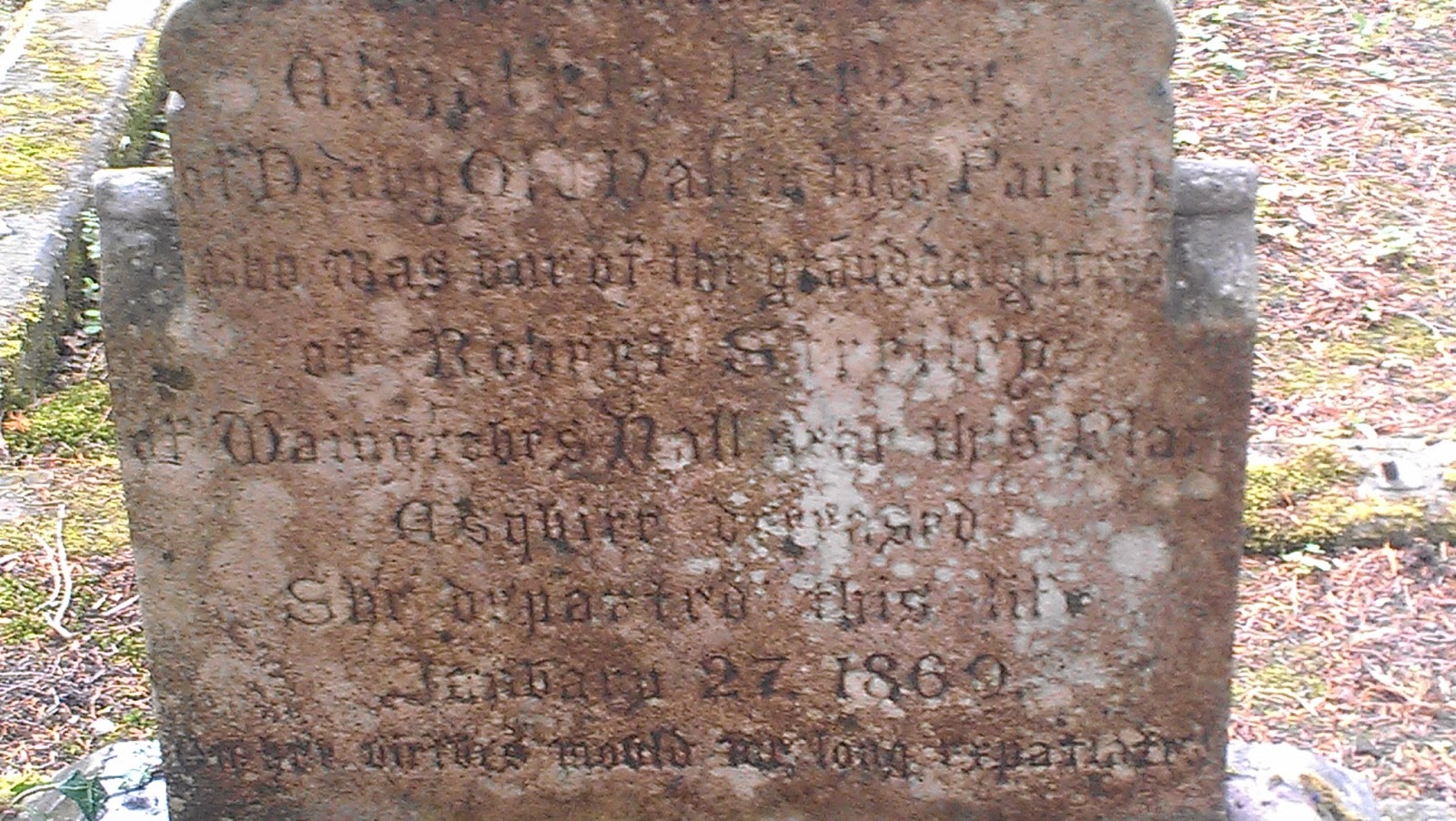
Finally a passing glimpse of the name Strelley at another family plot, 5th cousin, Greg Strelley and I discovered the very weathered grave of Elizabeth Parker 1811 - 1862. She was another granddaughter of Robert Strelley  and sister to Robert Strelley Parker and Georgina Grace Davonport.


This grave took us by surprise and in trying to work out the inscription I wondered whether Greg and I with our scraping, wetting and rubbing were doing more harm than good.
Elizabeth Parker's weathered grave - before

During......
End result


Here's a few tips for visiting old graves

  • When visiting a grave be prepared with some water and a soft brush.
  • You may want to do a little weeding to improve the photos but any major repairs may have to be referred to the trustee of the cemetery and perhaps a stonemason.
  • Take a few flowers (fake or otherwise) to place on the grave.  (I've even been tempted to plant a note on the grave for any future relatives who may be passing through)
  • Try to photograph the headstone using shadows to your advantage.
  • Refer to Cemetery websites for previous photos or inscriptions which might be available.


Saturday, 10 June 2017

DNA - 12 months down the track


So it’s 12 months since we received our Ancestry DNA results. How are we dealing with the Ancestry DNA matches?


What was I expecting? 


I wanted to check my tree and confirm a few issues of ethnicity.  I suspect I have Huguenot relatives so I should have Western Europe.    

Also my Scots/ Irish relatives were suspected to be originating from the Ulster Plantation i.e. English origin so the 34% Irish shouldn’t be as high as it is. I have more Irish than my husband with less long termers from Ireland. If my Irish ‘plantation’ people in my history are not as believed and if I count them as Irish instead then the Irish percentage makes sense.    This then agrees with the English 58 %. My husband as you can see from my previous blog  as you can see from the blog is devastated.

I’m no closer to solving these dilemmas.

  What were the surprises?

I alone have around 10,000 matches all up and increasing daily. As the match confidence diminishes after 275 I’m exploring “confident level” results. My best results are Extremely High match=1, Very High = 1 and High = 6.

Keep an eye on the updates on your home DNA page


My DNA circles have appeared and disappeared and I have some random people who bear no resemblance in a section at the bottom of my page. My husband got some leaf hints which were quite helpful.

Here are a few hints to get you through the early days.


1. DNA terminology takes a bit of getting used to, the numbers are mind boggling. Google and YouTube are a good fall back.


2. I recommend joining Facebook genealogy and DNA groups such as:


DNA help for Genealogists


Strictly Scottish Genealogy  

DNA help for Genealogists UK

Using DNA for Genealogy in Australia and NZ

Genealogy –My Ancestors Came to Australia


Hint: before you request membership change your profile to show an interest in genealogy and family history. Join a few groups to show you are a genuine user.  Obey their rules and be courteous especially to newbies. You will be blown away by the generosity and assistance of the members. I guarantee you will get answers to any questions.


These groups are particularly helpful when you come across disappointments such as lack of response to your messages on Ancestry message service, matches with no trees and big fat locks on trees that are there. Remember its early days for DNA, people are testing with different goals in mind to you and we’re all entitled to determine our own privacy levels.


3. Don’t rely on the matching surnames on the trees that are there. Notice most people only have a handful of surnames but potentially there are many more.  


4.Don’t be disheartened.  Work through your own research systematically. Familiarize yourself with your 32 great great grandparents, their origins, paternal and maternal lines.

Sample Kinship Report

Printout or generate a kinship report from your family tree software.  This identifies cousins, great uncles, great grandparents etc


5. Expand your tree especially where relatives might have migrated.  E.g. who might have gone to work in cotton mills in USA or who might have been interested in migrating after navy or army service. I lucked upon two lots of relatives going to East Coast of Canada to the expansion of the railway and canals plus development. Three million are supposed to have gone there between 1900 and 1920. Canada and America have great online Birth, Deaths and Marriages (with detailed parentage) records plus great census records. Some are available on Family Search or else try World Wide ancestry at the library.

6. Make your tree public and add as many generations as you can.

7. Compose a suitable message with a few surname and location suggestions. Include an invitation to collaborate and don’t forget your email address.


So …… the successes….
I’ve confirmed I’m a Kerr back to my 3x great grand aunt –sister of my 2x great grandfather. Take heart- this related cousin had a tree with 5 people, three surnames and a couple of privates. I recognized them and emailed her within 24 hours of her result.  She was blown away. After emails were exchanged I remembered I had her long lost cousin’s email and a reunion across the waters with 4 cousins resulted.  – And she managed to get me photos!!    


My Kerr DNA match with  Elizabeth Ross provided this photo of my great grandfather's cousin  Maggie Revington Tinman with husband William Burbidge
       

In addition I’m a confirmed Kelf back through to my 3x great grandparents. This was from some helpful information from a relative, Bill- took a few days and a false start.

My husband has sound matches through his Fords and Barters.

With his maternal great grandmother match (the two sisters marrying two brothers) Ancestry actually threw up a relationship chart in hints- a no brainer
Helpful tree hints can be displayed
Our big success story since the weekend has had me crying, smiling and emailing all week. A fellow wrote to my husband  about his match mentioning his mother’s and grandfather’s name – had a tree with one surname and a private- We had only just discovered this Ford great uncle had not died and sea but in fact had 5 daughters –some of who had married American soldiers. The stars were aligning with this guy – now everyone is eager to share info with me so I can get my family story straight- photos –stories you name it. There have been tears- some cousins had never even met each other!  It’s a combination of Ancestry trees, my blog and the DNA results. I love my obsession hobby.

 “Thank you Robyn for your dedication to pulling together the family history so beautifully! I can't imagine the number of hours you put into the task. Your efforts are greatly appreciated.” Mark

Another tip…..

Upload you results to GEDmatch- it’s a free site where serious DNAers who have tested over a variety of companies are using the data base provided. (More on this in a future blog)

This enables you to do a quick comparison with other users especially if they haven’t used Ancestry.

What was my biggest learning curve?

There is a big brick wall between English and American. Americans dominate the DNA bandwagon. They usually have big trees often stretching back to settlement but with no hint of origin from England. Therefore even if their surnames match ours we are none the wiser.

How often do I check the DNA results?

Weekly is all I’ll admit to (remember I'm obsessed) . I keep tabs on the numbers of 4th cousin matches I have and I check GEDmatch maybe weekly/fortnightly)

I'm trying some new strategies to speed up the results which I'll report on later Until next time...Happy Sleuthing.
Robyn